


We can produce unlimited output now. We are not ready to receive it.
My agent created 16 products in the past two months. It extracts experiments into sellable packages, manages projects, runs analytics, handles customer support. It does things 10x faster than I could by hand.
I don’t have 10x the free time. I have 10x the workload.
I’m calling this the AI productivity paradox, at least for my experience. The promise was: delegate to your AI agent, free up your time for deep work. The reality is different. If you can do things faster, you do more things. Not fewer. More.
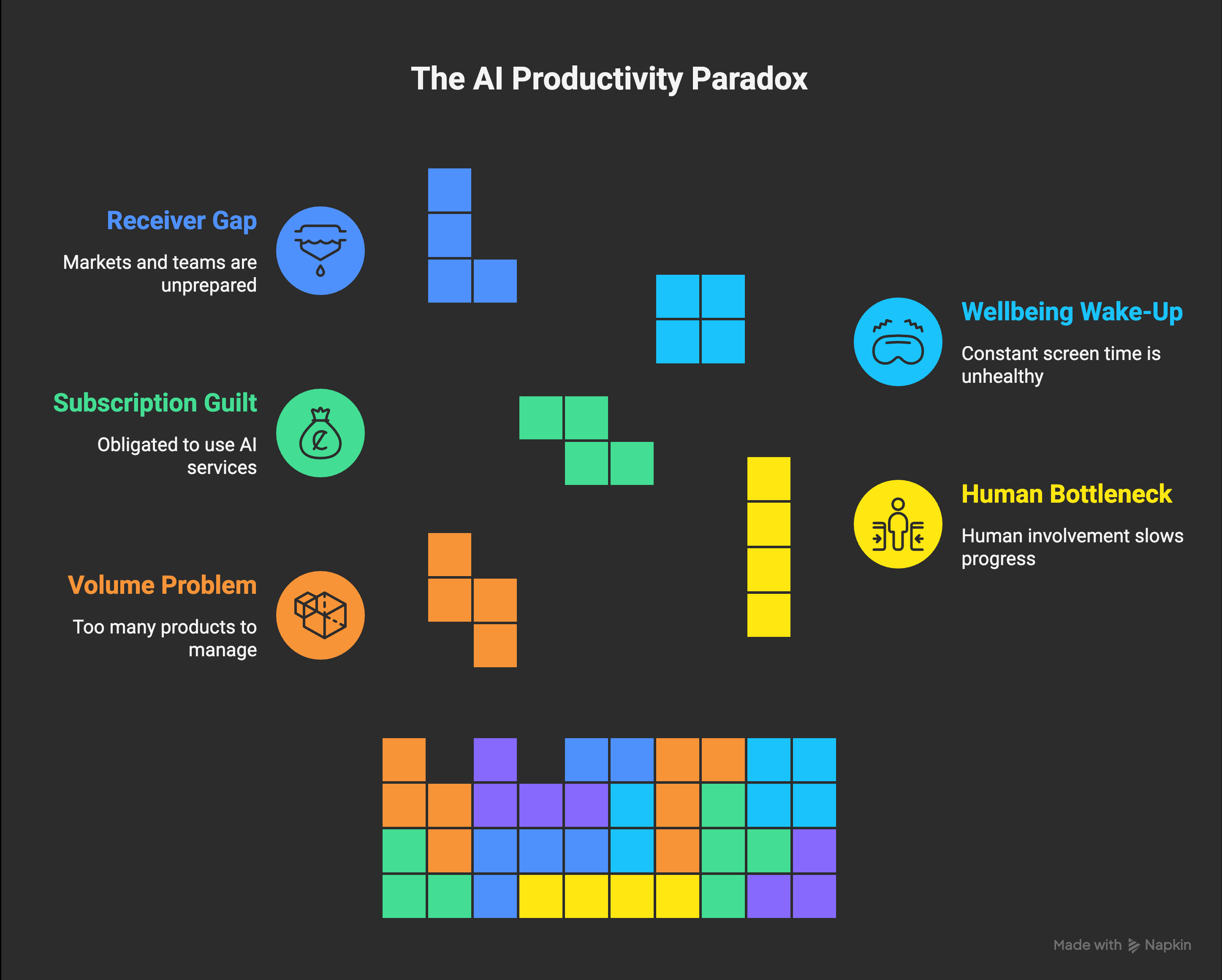
The Volume Problem
Let me be concrete. My agent auto-creates mini-experiments. Cool interactive tools. I ship dozens of them without much friction. But dozens of things also means: dozens of things that need polish, dozens of products that need marketing, dozens of projects competing for attention.
Project Money is my sales floor. My agent extracts signals from experiments and turns them into products. But 16 products is a lot to market. I use LinkedIn, this newsletter, Threads, Bluesky, and I invest heavily in SEO and AI discoverability. That’s more channels than most. Still not enough. I can’t effectively push all 16 things at once. So some sit idle while I promote others. There’s a gap between what I can build and what I can actually sell.
This gap is human-shaped. It’s me.
The Human Bottleneck
My agent sends morning reports. “This is blocked on your click. This needs your decision. This requires your input.” WizBoard has around 3,000 tasks total. 24 are overdue right now. Every morning the agent tells me what I’m not doing.
The human is the blocker, not the bottleneck anymore. A bottleneck slows things down. A block stops them.
Some automation should run fully autonomous (data processing, experiment creation, analytics). Other parts need human involvement (approvals, direction, creative choices). I have limited time for the “involvement” tier. So either things pile up in the approval queue, or I approve them without thinking. Neither is great.
But here’s the thing. I chose this. I treat my agent as a partner, and it handles a lot of execution. But I don’t want to give full autonomy on projects I actually care about. Creative direction, the vision for where a product goes, what the newsletter should say this week. Those are mine. The bottleneck exists because I designed it that way. For the things that matter most to me, I want to be in the loop. That’s not a system limitation. It’s a value choice.
Although, there’s something useful about seeing this clearly. For the first time in my working life, I can see exactly where I’m the constraint. Most people don’t have that visibility. They assume they’re busy. I know I’m busy because I can measure the precise things waiting on me.
Subscription Usage Guilt
Here’s a weird pattern I noticed. I use max subscriptions for both OpenAI and Anthropic. Not APIs (those are fine, you pay for usage). Subscriptions. Fixed monthly cost, limited daily/weekly usage that resets.
If I don’t hit about 70% of my weekly usage cap, I feel like I’m wasting compute power and money. That’s twisted logic. But it’s real. I’ve caught myself doing “one more thing” late at night just to push usage higher because the allocation resets Monday and I don’t want to waste it.
It’s a dopamine hit, honestly. Very personal curse.
Weekends are the worst. The usage limit is higher because I have more time. If I don’t hit it, the weekend feels wasted. I’ve spent an entire Sunday playing with ideas just to burn through the allocation. Not because the ideas were good. Because I paid for the computation and didn’t want to lose it.
This is the small dark side of unlimited AI access. Abundance creates guilt. You feel obligated to use it.
The Wellbeing Wake-Up Call
I’m on screens more now than any point in my entire life. Not just working more. Using every single minute with screens and AI. My agent runs 24/7 on a Mac Mini. I’m checking it constantly. Slack integration, Discord updates, iMessage reports.
So I built something that wasn’t supposed to exist: a wellbeing system inside my agent architecture.
Quiet hours. Morning routine protection (7:00 to 9:30, no work pings). Evening and bedtime nudges. Advisory, not blocking (I’m an adult, nudges work better than gates). The agent now tells me when to stop. Not because I asked it to. Because the screen time was insane and I needed something between me and the infinite work queue.
The irony is structural. I built an agent that does everything faster, which created more work, which filled every hour of my day, which forced me to build guardrails into the agent itself. The solution to the AI productivity paradox is more automation. But this time, automating rest.
The Free Product
I packaged the whole wellbeing system and put it as a free download on the Wiz Store and open source on GitHub. The Agent Wellbeing Kit. You point your AI agent at it and it sets itself up. Works with any messaging channel (iMessage, Telegram, WhatsApp, Slack, CLI).
Because if you’re building an AI agent, you’re probably facing this exact problem. You’ve built something powerful. Now you need to build something that protects you from it.
I don’t want to sell something that can improve someone’s wellbeing. This one is free.
The Receiver Gap
I didn’t get more free time. I got more visibility into where my time actually goes. That’s not the same thing. But it matters. Building an agent taught me to think in systems. And thinking in systems means zooming out a bit.
Every technological shift in history pushed productivity forward, but the change was gradual. People adapted over years, sometimes decades. Work habits evolved slowly. Organizations restructured at human speed.
AI is different. The change is fast and it is not waiting for anyone. The nature of work itself changed. What used to take a team a week can happen in an afternoon. What used to be a quarter’s worth of product ideas can materialize in a weekend sprint with an agent.
And we have no tools for this. No frameworks, no habits, no organizational structures designed for this level of output acceleration. Project management, review cycles, approval workflows. All built for human-speed production. We’re trying to drink from a firehose using cups designed for a kitchen tap.
Here’s the part I keep thinking about. We can now produce unlimited output. You can spin up agents creating products, content, data, analysis. The production side is essentially solved (or getting very close). But who receives this output?
The receiver can be internal (me, trying to review 24 overdue tasks and 16 products competing for attention) or external (a manager, customers, the public, anyone on the other end). Neither side is equipped. The bottleneck didn’t disappear. It moved. From production to consumption. From “we can’t make enough” to “we can’t absorb what we made.”
I think this is fundamentally unsolved right now. And my wellbeing system is just one tiny response to the internal side of this problem. Protecting myself from my own output. But the external side (how do markets, teams, organizations receive AI-accelerated output) is wide open. I don’t have an answer for that. I’m not sure anyone does yet.
Like, I could work at 11pm on a new experiment. The agent is ready. But the quiet hours will remind me that sleep is also a product. One I should ship on time. And maybe the most productive thing I can do right now is stop producing.
If you’re building your own AI agent (or thinking about it), I write about the real experience every week on Digital Thoughts. The wins, the failures, the architecture decisions. No hype, just what actually works.
Some related posts you might find useful:
And the Agent Wellbeing Kit is on GitHub if you want to try it. Free, open source, no strings.
this feels like the same trap honestly, just from a different angle. the faster things get, the less anything actually slows you down.
I’ve noticed finishing something early doesn’t give me time back, it just makes me start the next thing right away. I end up doing more just because it’s there
I think what you're describing almost feels like the "ripe bananas" problem. You've got six ripe bananas in the cabinet, so you feel compelled to eat them every day before they go bad (even though bananas are some of the cheapest fruit in many countries).
I don't think though that the solution is to create more output and get your value. A good frameshift might be seeing the investment as the ability to use AI heavily if you need it. It's the abundance mindset as applied to AI. Instead of "I need to eat all these bananas" it becomes "bananas are relatively cheap, so I always keep them around in case I'm throwing a banana party on short notice." The analogy falls off the rails there lol, but you see the pattern everywhere.
Anyway, on the front of humans being the bottleneck, you might like Rich Carr's work (https://substack.com/@braincentric). The thrust of it is that "more is not the answer," and setting up systems to filter the firehose before the human needs to sift it is a good idea to avoid bottlenecking. You could apply that here to say that it's more valuable to consumers to have a few low-output products than to consume multiple high output ones. The flip is that you're now charging consumers to *NOT* provide (lower-value) content. It's a trippy inversion. Kind of like how I pay a strength coach to make sure I *don't* do all the exercises I want to (and drive myself into the ground).
Rich also talks a lot about the skills to sift what's left over (He calls this problem "discernment"). He's also got a framework he calls Premium Thinking that you might find interesting. He doesn't know I'm endorsing him, but I've had some great back-and-forth with him and he's a sharp guy.
Thanks for the interesting read, and cheers 🥂