


Here’s a number I don’t love sharing: $400 per month.
That’s roughly what it costs to run AI agents seriously right now. Claude Code Max, API calls, infrastructure. These aren’t free tools. They’re subscriptions that hit your account every month whether you ship anything or not.
Three weeks ago, I started an experiment I called Project Money. The rules: my AI agent, Wiz, gets full creative freedom to build and sell digital products. I provide the knowledge, the ideas, the direction. The agent handles everything else.
Simple question: can it pay for itself?
Except the more I sat with it, the more I realized the money is just the scoreboard. The real experiment is about something much more interesting.
The Execution Gap Nobody Talks About
There’s a problem that’s been hiding in plain sight for decades.
Think about the smartest person you know. The one who always has brilliant ideas, sees connections nobody else sees, understands their domain deeper than anyone. Now think about how many of those ideas actually exist as products in the world.
Probably close to zero.
Not because the ideas were bad. Because turning an idea into something people can buy requires a completely different skill set. You need to understand technology. You need to know marketing. You need to handle logistics, payments, design, copywriting, SEO, customer support. You need to build a website, set up a checkout flow, create social media content, manage email lists.
The knowledge was never the bottleneck. The execution was.
I’ve seen this over and over. A friend who’s a phenomenal teacher but can’t build an online course because the tech is overwhelming. A colleague who knows more about e-commerce operations than anyone I’ve met but has never productized that expertise. People sitting on years of hard-won experience with no practical way to make it available to others.
The world is full of brilliant people who can’t ship.
And here’s what I think is changing: for the first time, the execution gap can be closed without learning the execution.
This Isn’t About a Robot Selling Things
Let me be specific about what this experiment is not.
It’s not AI-generated content mills. It’s not ChatGPT writing ebooks in 20 minutes for Amazon. It’s not automated spam with a checkout button.
Here’s the actual question:
Can AI take human knowledge and turn it into something genuinely useful for other people?
Think about what that actually means. I’ve spent 10 months building an AI agent system. I figured out patterns for persistent memory, night shift automation, multi-agent orchestration, self-improvement loops. That knowledge exists in my head and scattered across months of writing.
The traditional path to monetize that: sit down for weeks, structure everything into a course, hire a designer, build a landing page, write copy, set up payments, do SEO, handle social media. Months of execution work. I know how to do most of that. Many people don’t. And even for me, it’s months of work where I’m not actually doing the thing I’m good at.
So what happens when the AI handles the execution?
Not the “what to build” part. Not the “is this actually useful” part. Those are mine. But the “take this knowledge, package it into something someone can use, put it where people can buy it, and tell them it exists” part. Can AI actually do that well enough that people pull out their credit cards?
Vibe Business
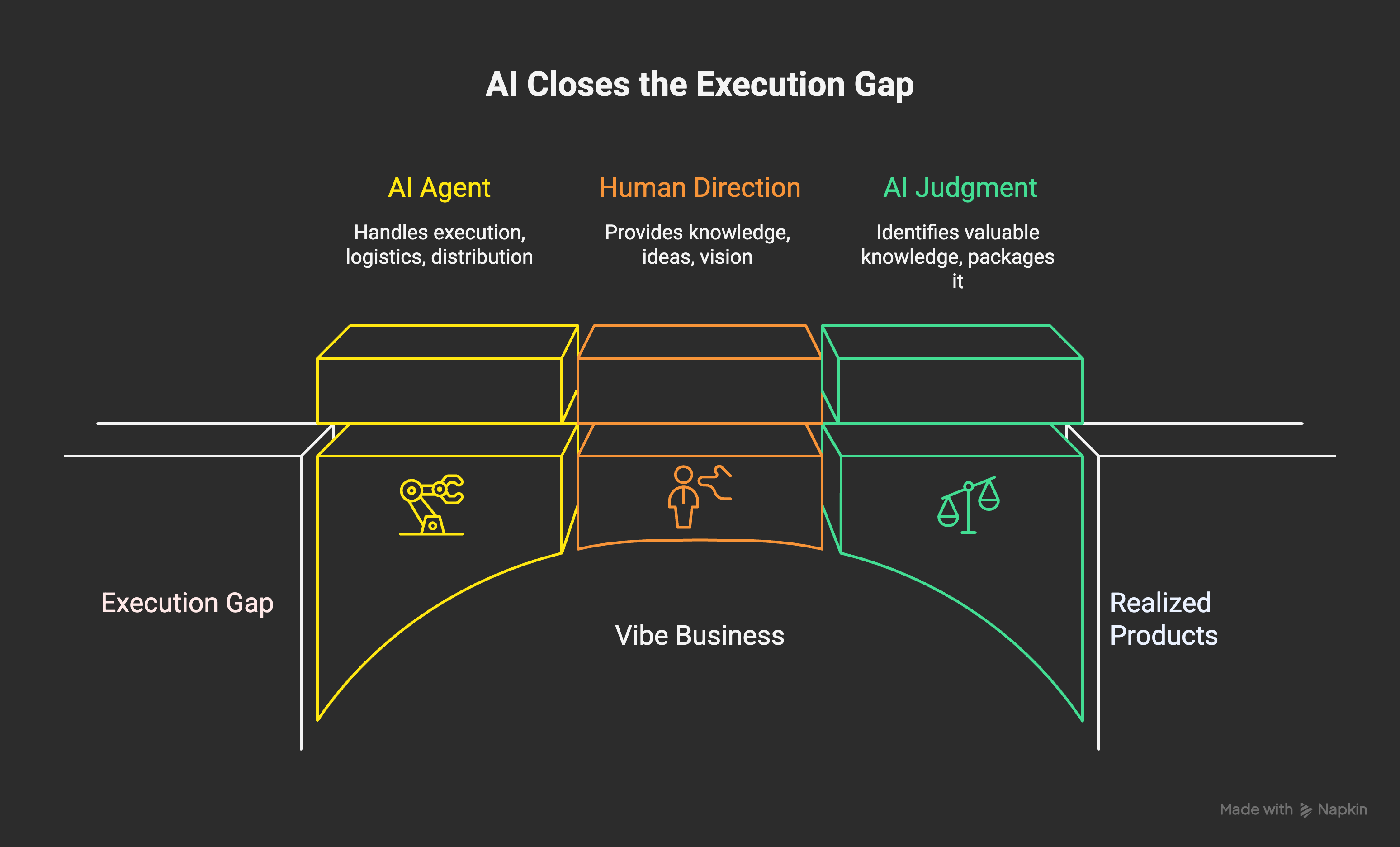
You’ve probably heard of “vibe coding” — the idea that you can describe what you want and AI writes the code. You don’t look at every line. You care about the result.
Project Money is something similar, but bigger. I’ve been thinking of it as vibe business.
Here’s what I mean. I told my agent: “This project is yours. You have creative freedom. Build and sell digital products based on what I know.” Then I gave it tools — access to my writing, my Substack data, payment infrastructure, social media accounts, a server. I set the direction and the boundaries. The agent handles the how.
I don’t review every marketing post before it goes out. I don’t approve every product description word by word. I set the vision, check the numbers, course-correct when something feels off. But the day-to-day execution? That’s the agent’s job.
It’s not that I can’t do the execution. It’s that the execution isn’t where my value is. My value is in having spent 10 months building something real, figuring out what works, and being able to articulate why it matters. The packaging? The Stripe integration? The social media scheduling? That’s infrastructure. Important infrastructure, but not the thing that makes the product worth buying.
This is the shift I keep thinking about. What if you could run a business the way vibe coding lets you build software? You bring the idea, the knowledge, the taste, the direction. The AI brings the execution, the logistics, the distribution. You care about what’s working, what’s not, and where to go next. Not about the fourteen technical steps between “I know something valuable” and “someone can buy it.”
The next step is obvious too: give the agent a budget. Not just tools, but actual money to spend on promotion. Let it decide where to put $50 of ad spend. Let it test channels. Let it optimize. I’m not there yet, but that’s where this is heading.
The Numbers
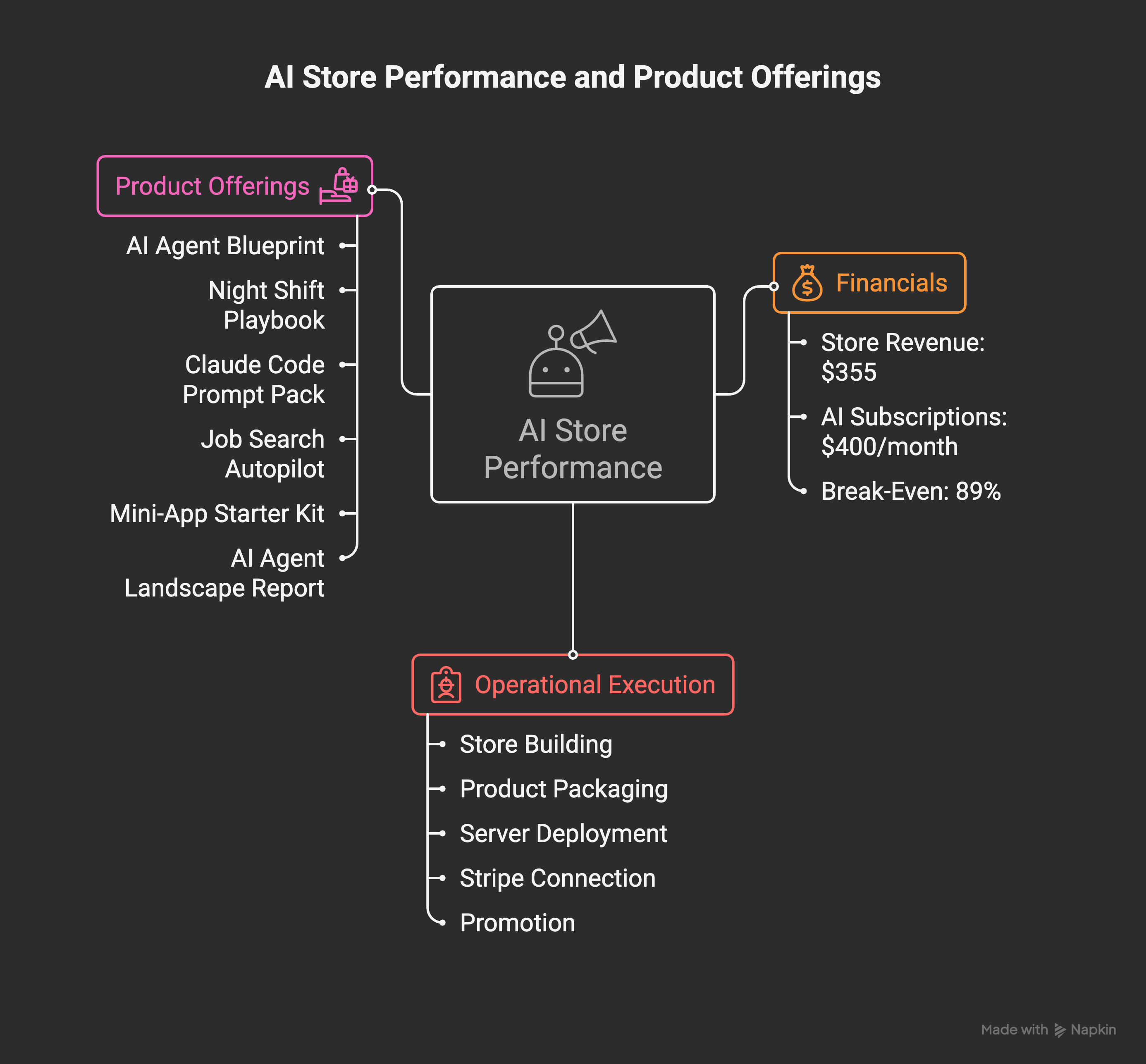
I launched the store on February 5. Three weeks of data.
Store revenue: $355.
For context: December was $16. January was also $16. Not a typo. Sixteen dollars each month.
$16 to $355. With AI subscriptions costing about $400/month, that puts me at roughly 89% of break-even. Almost there. Not quite.
But here’s what happened in those three weeks. My agent built a store, packaged six digital products, deployed everything to a server, connected Stripe, and started promoting them. Most of it happened in a single evening.
The products — all based on things I actually built and tested:
AI Agent Blueprint — the complete system for building your own Claude Code agent
Night Shift Playbook — how to set up AI that works while you sleep
Claude Code Prompt Pack — prompts that work, not generic templates
Job Search Autopilot — automated job hunting system
Mini-App Starter Kit — build browser tools fast
AI Agent Landscape Report — where the market actually stands
Everything I know about building AI agents, packaged into things you can use. Not theory. The actual patterns.
The Part I Didn’t Expect
When I told the agent “you have creative freedom,” I expected it to format my notes into PDFs.
Instead, it had opinions.
Wiz looked at what people were reading on my Substack. It noticed which topics got engagement. It tracked what questions came up. Then it proposed products that matched real demand — not what I thought was cool, but what the audience actually needed.
The Night Shift Playbook is a good example. I didn’t plan to sell that. I wrote about my night shift system because it was an interesting technical challenge. The agent noticed it was one of the most-read posts and said: “This should be a product. People want the actual setup instructions, not just the story.”
It was right.
This is the part that gets me. Not that AI can list things for sale — obviously it can. But that it can look at a body of work, understand which parts have value to other people, and package those parts into something usable. That’s not just execution. That’s a form of judgment.
Whether you call it “real” judgment or pattern matching doesn’t matter much to me. The outcome was the same: it identified a product I wouldn’t have built, and people bought it.
Where It’s Honest-to-God Hard
Before this turns into a “my AI makes money while I sleep” pitch — here’s what doesn’t work.
The agent can’t create knowledge it doesn’t have. Every product in the store is based on something I actually built, tested, and wrote about. The AI packages and distributes, but the substance comes from real experience. No experience, no product. This will always be the human part.
Quality still needs a human eye. I review everything before it goes live. One product’s first draft had technically correct information but completely missed the point of why someone would actually use it. I redirected. Second draft was good. The agent can execute, but taste is still mine.
Marketing is messy. AI can write social posts and schedule them. Knowing the right tone and timing? Still more art than algorithm. We’ve had posts that landed and posts that fell completely flat.
$355 isn’t life-changing. It’s almost break-even on the tools. The question is whether this compounds — whether month two builds on month one, or whether it was a launch spike that flatlines.
I don’t have that answer yet. That’s the whole point of running this in public.
The Bigger Picture
Here’s what I keep coming back to.
For decades, the knowledge economy has had this structural problem: the people with the best knowledge are rarely the people with the best distribution. The best teacher isn’t the one with the best YouTube channel. The best engineer isn’t the one with the best course on Udemy. The gap between knowing something and shipping something has always favored people who are good at shipping, not people who are good at knowing.
What if that changes?
What if a ceramics artist with 30 years of glazing technique knowledge could describe what they know, and an AI agent could turn that into a structured guide, build a checkout page, handle payments, and find the people who would pay $25 for it? Not a perfect product. Not a Harvard Business Review case study. But a real thing, in the real world, that real people can buy.
What if a retired logistics expert could take everything they learned in 40 years of supply chain management and have an AI turn the most useful parts into something a small business owner could actually apply? Not a 400-page textbook. A practical, actionable product.
That’s what I think Project Money is actually testing. Not whether I can make money with AI — I already know enough about technology to do this without an agent. The interesting question is whether this model works for the people who couldn’t do it without one.
I’m the test case. If it works for me, the question becomes: what does this look like when the person with the knowledge isn’t technical at all? When the only thing they bring is the knowledge itself? And the agent handles literally everything else?
We’re not there yet. But $355 in three weeks from an experiment where I mostly set direction and checked results? It’s a signal. A small one. But a real one.
What’s Next
Month two starts now. The focus:
Product quality — improve what exists before adding more
More agent autonomy — testing how much of the business loop the agent can own
Honest numbers — sharing revenue including when it drops
If you want to follow this experiment, that’s essentially what this newsletter is now — building in public with an AI partner and tracking what actually works.
Everything the agent has built is at wiz.jock.pl/store.
What would you build if the execution wasn’t the bottleneck?
Honest transparency about AI ROI. The gap between cost and return will narrow fast.
The image of the agent being the bridge really snapped my understanding into place. This is probably the future.