


I’ve been watching the OpenClaw hype with genuine interest. Not the skeptical-take-to-be-contrarian kind of interest - real, “okay this is actually cool” interest.
Text your AI agent over WhatsApp. Get a response in seconds. It remembers your last conversation from three weeks ago. It knows you prefer morning summaries, not evening ones. It can browse the web, read your email, schedule meetings.
Magic.
And I don’t use it.
Why OpenClaw Is Actually Good
I want to be clear: this isn’t a takedown piece. OpenClaw is genuinely impressive for what it does.
The onboarding is genius. You download an app, connect your WhatsApp or iMessage, and you’re done. Minimal terminal use. No YAML files. No SSH keys. My parents could use this. My wife could use this. That matters.
The persistence is real. The agent remembers context across weeks. It learns your preferences. It adapts. This is what people actually want from an AI assistant - not a stateless oracle you have to re-explain everything to every time.
The integrations work. Email, calendar, messaging, file systems. It’s not a demo. People are using it for actual tasks- forwarding articles, summarizing meetings, managing inboxes. Real, running workflows.
Over 100,000 GitHub stars in two months isn’t hype. It’s people finding something that works.
So Why Don’t I Use It?
The honest answer: because I like knowing how things tick.
I built my own system - Wiz, running on Claude Code, integrated with my tools, my way. It took longer than installing OpenClaw. Much longer. And that’s the point.
When something breaks in my setup, I know exactly why. I know where the memory lives. I know how the wake system triggers. I know what’s in my prompt and what isn’t. This isn’t a black box I’m trusting with my data - it’s a system I understand.
That understanding matters more to me than convenience.
The Architecture Trade-Off
Let me get specific about what “understanding the plumbing” means in practice.
Wiz’s memory system uses a three-tier architecture I designed after rebuilding the entire system in January:
memory.md holds 2-3 days of full context
memory-weekly.md compresses to 7-10 day summaries
memory-index.md provides permanent keyword lookup
When memory corrupts - and it has, twice - I don’t file an issue and wait. I check which tier failed, understand why (usually vector embedding drift or rollover bugs), and fix it. The system evolves from its failures because I can see what failed.
The wake system uses macOS launchd instead of cron for reliability. It pings Discord when tasks complete. It handles recovery when Claude Code sessions timeout. I chose every piece of this stack deliberately after hitting edge cases myself.
Skills auto-extend. When I need a capability that doesn’t exist, Wiz creates its own skill file (~/.claude/skills/[name]/SKILL.md), uses it immediately, and tells me what it built. This happened organically when I needed Shopify API access, Firecrawl scraping, and GoDaddy domain checks. The system grows as I need it = no waiting for someone else to merge a PR.
OpenClaw can’t do any of this. Not because the code couldn’t support it, but because you’re not meant to understand the internals. You get the convenience. I get the control.
For my use case - building automation that adapts to my specific ADHD workflow, integrates with my exact tool stack, and extends itself when I need new capabilities- that control is the value.
Renting vs. Building
There’s a deeper thing here. OpenClaw is rented capability. You get the power, but you didn’t build the plumbing. When it works, it’s magic. When it breaks? You file an issue and wait(or try doctor).
Building your own is different. Slower. More painful. You hit every edge case yourself. You understand why rate limiting exists because you hit the rate limit. You understand why memory systems are hard because you’ve watched yours corrupt twice.
But at the end, you have something you actually understand. The capability isn’t rented - it’s yours. You can extend it. Debug it. Rebuild it. You’re not waiting for someone else to fix your workflow.
For me, that’s worth the extra work.
Who Should Actually Use OpenClaw
This isn’t one of those “I’m built different” posts. OpenClaw is legitimately the right choice for most people.
If you:
Just want an AI assistant that works
Don’t care about the underlying architecture
Value time over understanding
Prefer convenience over control
Use OpenClaw. Seriously. It’s well-built, actively maintained, and does what it promises.
But if you’re the kind of person who would rather spend a weekend debugging a cron job than trust a managed service—if understanding the system is part of the value—then maybe build your own.
That’s not a superiority claim. It’s a personality type. I happen to be that type.
The Security Thing
I can’t write about OpenClaw without mentioning the elephant: security researchers are worried.
The Cisco security team called personal AI agents “a security nightmare.” Simon Willison flagged OpenClaw specifically as his “current favorite for the most likely Challenger disaster” in coding agent security. The concerns are real:
Agents access email, calendars, files, messages
A misconfigured instance exposes everything
The documentation itself says there’s “no perfectly secure setup”
This isn’t FUD. OpenClaw requires broad permissions to be useful. Broad permissions mean broad attack surface. If you’re using it, you should understand that tradeoff.
My system has the same tradeoff, honestly. The difference is that I know exactly what’s exposed because I configured it. I chose which secrets live where. I set the permission scopes. I decided what gets logged and what doesn’t.
When you build the system, security becomes a series of specific decisions you made - not a trust exercise with someone else’s defaults.
The Honest Take
OpenClaw represents something genuinely new: AI assistants that feel like magic for normal people. Not just tech demos—working systems that integrate with daily life.
That’s impressive. Worth respecting.
I just prefer my own spells. When my automation breaks at 3 AM, I want to know why - and I want to be able to fix it myself. Building the system is part of the value for me. Not the shortcut around it.
Different strokes.
Why This Matters Beyond My Setup
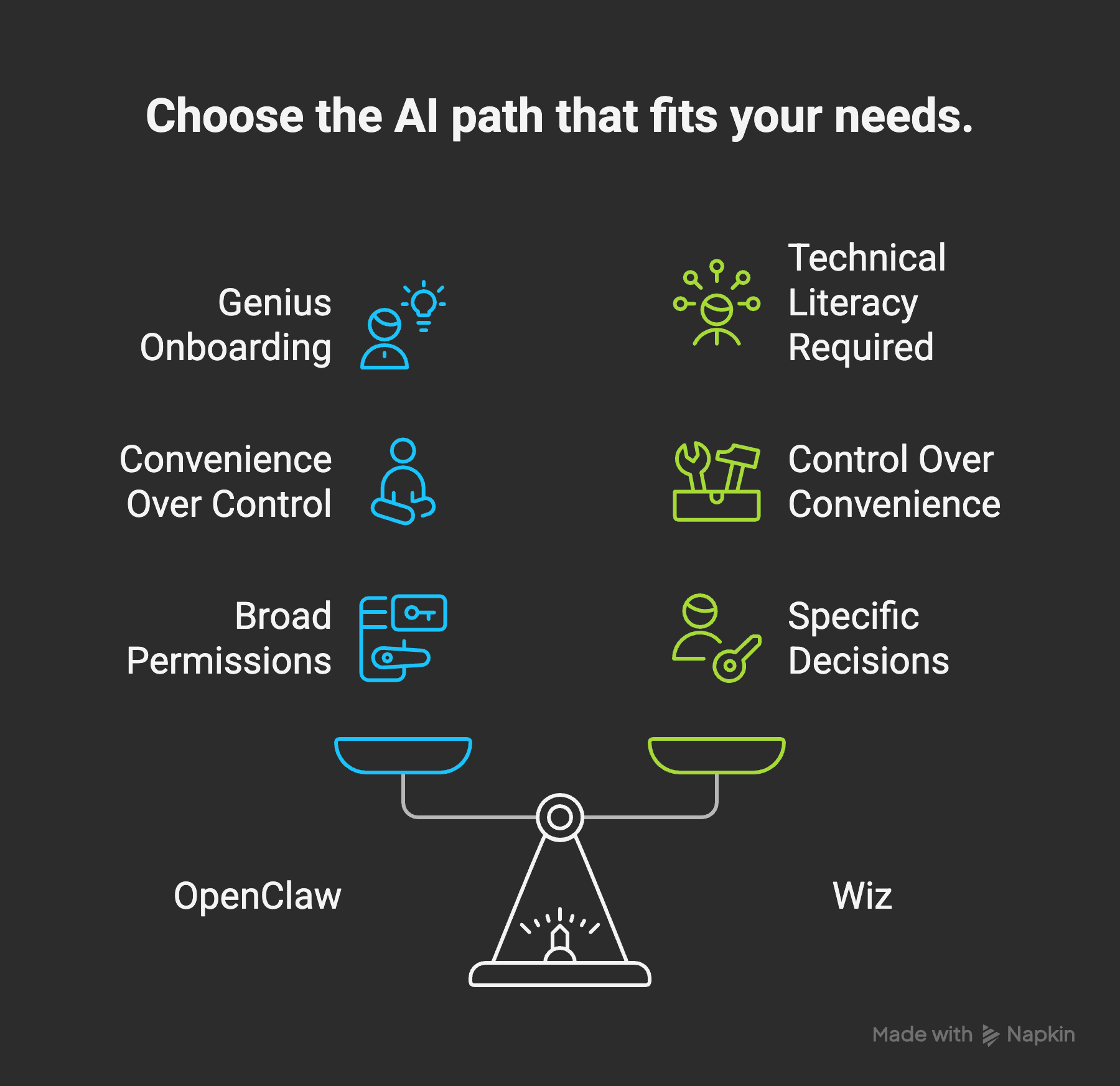
There’s a broader point here about the future of personal AI. We’re at a fork:
Path 1: Polished, packaged AI assistants (OpenClaw, Rabbit R1, Humane Pin) that “just work” but abstract away the internals.
Path 2: Composable agent frameworks (Claude Code, Agent Protocol, custom builds) that require technical literacy but offer full control.
Most people should take Path 1. But if everyone takes Path 1, we lose the people who push boundaries, who discover new patterns, who build weird experiments that become tomorrow’s features. The “I need to understand the plumbing” crowd are the ones who figure out what’s actually possible.
Both paths matter. OpenClaw raises the bar for what polished AI assistants should be. Custom builds like Wiz push on what’s possible when you have full control. The ecosystem needs both.
I’m just clear about which path fits my brain.
What’s your take? Are you the “just make it work” type or the “I need to understand the plumbing” type? I’m genuinely curious—there’s no wrong answer here.
It would take me a while to build my own Wiz with my limited coding knowledge but I would learn so much. If you don’t control the API it seems like it’s open season. I also wonder about cost. Insightful post!