


NOTE: Clawdbot had to rebrand, because of Anthropic(meh). First it was Moltbot and now it’s OpenClaw.
So here’s a confession I’ve been sitting on for a while...
Wiz exists because of Clawdbot.
I could tell you I independently discovered the need for a persistent AI assistant. That my two-tier memory system was some stroke of genius that came to me during a late-night coding session. But that would be dishonest.
The truth? When Peter Steinberger started posting about using Claude as his “primary computer” earlier this year, something clicked. I’d been playing with AI tools for months - building that Dynamic Claude Chat system, experimenting with MCP integrations. But Steinberger’s approach was different. Bolder. He wasn’t just giving Claude memory. He was giving it hands.
And I watched all of this thinking: I want to build something like this.
Not just use it. Build it. Because that’s who I am.
The Viral Phenomenon Nobody’s Being Honest About
Let me give you the numbers first, because the scale is genuinely staggering.
44,000+ GitHub stars. 8,900+ Discord members. From 5,000 to 20,000 stars in less than two days. MacStories calling it “the future of personal AI assistants.” Logan Kilpatrick, Google AI Studio’s head, posting about ordering a Mac Mini just to run it. A noticeable surge in Mac Mini purchases directly linked to Clawdbot excitement.
The hype is deafening. “Open source built a better version of Siri while Apple (a $3.6 trillion company) slept for years” - that’s the vibe.
But here’s the thing. Most coverage is suspiciously one-sided. So let me give you the full picture, the one nobody else is writing.
What Federico Viticci Actually Found (180 Million Tokens Later)
Federico Viticci from MacStories went deep. Really deep. He burned through 180 million tokens in his first week. Let that sink in. 180 MILLION tokens on the Anthropic API.
His verdict? “To say that Clawdbot has fundamentally altered my perspective of what it means to have an intelligent, personal AI assistant in 2026 would be an understatement.”
But read the details. He:
Runs an M4 Mac Mini ($600) with silent operation
Pays $200 monthly for Claude Max on top of that hardware cost
Replaced his $15/month Zapier subscription
Built a TV remote using voice commands
Automated newsletter workflows that “used to take hours”
Created a multilingual voice assistant that switches between Italian and English
His assistant, which he named “Navi” (inspired by the fairy from Ocarina of Time), can receive audio messages, respond with ElevenLabs-generated voice, generate images with Gemini, and even improve itself by writing new skills.
As he put it: “There’s no going back after wielding this kind of superpower.”
That’s one side.
The Hacker News Reality Check (And It’s Brutal)
Now here’s what the cheerleader articles don’t mention.
I went through the Hacker News threads. The real opinions from people actually using this thing.
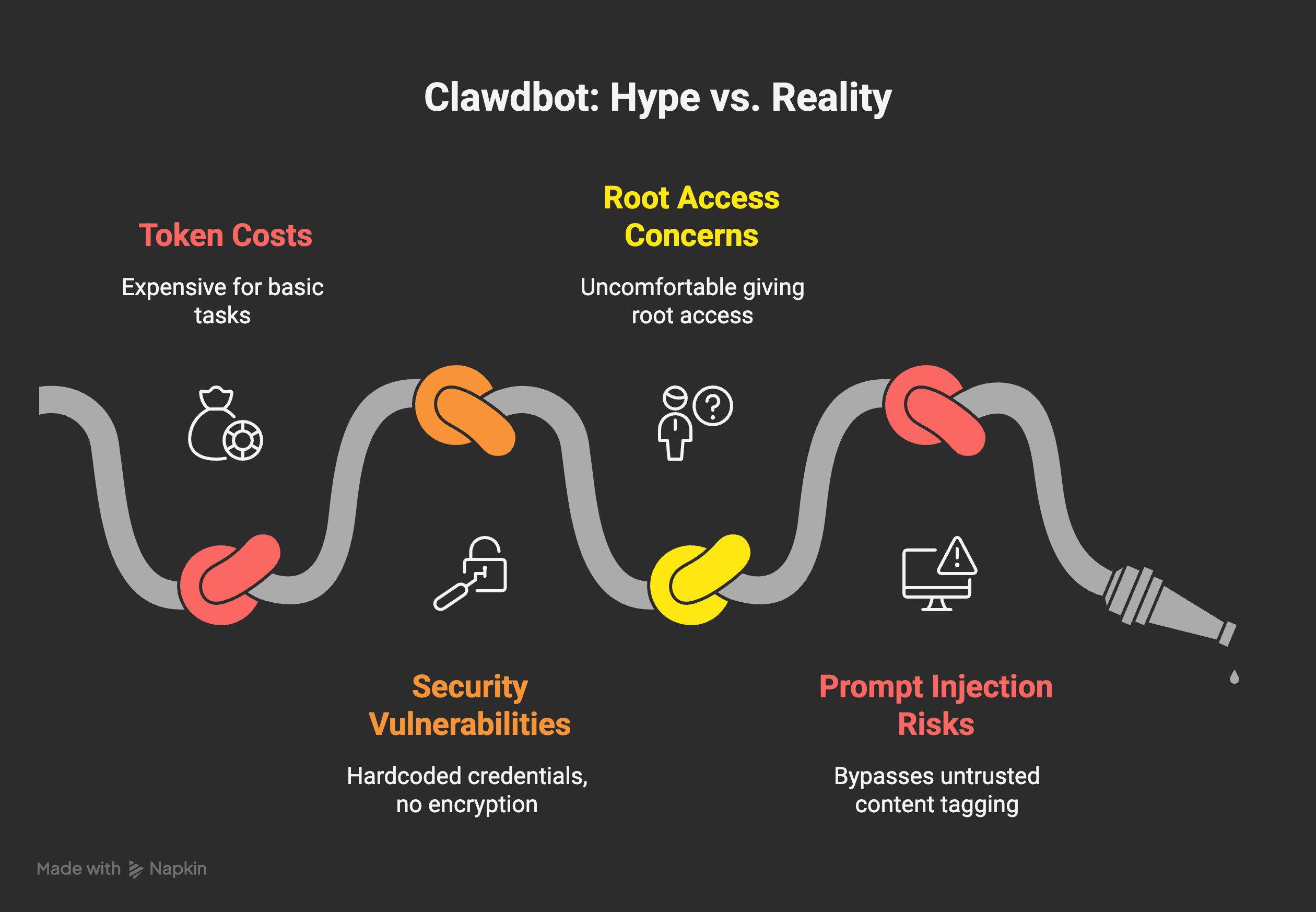
mgdev (19 hours ago): “It chews through tokens. If you’re on a metered API plan I would avoid it. I’ve spent $300+ on this just in the last 2 days, doing what I perceived to be fairly basic tasks.”
$300 in two days. For “fairly basic tasks.”
xtagon flagged 300+ open GitHub issues, including an AI-generated security report claiming “hundreds of high-risk issues” with hardcoded, unencrypted OAuth credentials.
vanillameow: “Uncomfortable giving an AI root access unprompted 24/7.” Even if sandboxed.
suriya-ganesh: Security practices are “going out the window” - giving root access to internet-connected processes without guardrails poses serious risks.
lmeyerov demonstrated that web-fetching bypasses untrusted content tagging, leaving systems vulnerable to prompt injection from webpage content.
And my favorite dystopian comment: “The real ultimate Skynet is Clawdbot.”
The Security Situation Is Genuinely Concerning
This isn’t FUD. The numbers are real.
SOCRadar’s analysis found over 1,009 Clawdbot gateways exposed to the public internet. Many completely unauthenticated.
A comprehensive security audit identified 512 security findings including 8 critical vulnerabilities. OAuth tokens stored in plaintext JSON files. No encryption at rest.
Cybersecurity News reported that hundreds of exposed gateways leave API keys and private chats vulnerable.
Former U.S. security expert Chad Nelson warned that Clawdbot’s ability to read documents, emails, and webpages could turn them into attack vectors.
Notable figures like entrepreneur Rahul Sood recommend users operate Clawdbot in isolated environments, use new accounts, temporary phone numbers, and separate password managers.
The Clawdbot team is honest about this in their FAQ: “Clawdbot is both a product and an experiment: you’re wiring frontier-model behavior into real messaging surfaces and real tools. There is no ‘perfectly secure’ setup.”
I appreciate that honesty. Most AI tools pretend the risk doesn’t exist.
But Here’s Why People Are Losing Their Minds Anyway
Despite all that, people are genuinely doing remarkable things with it.
jason_tko used his Clawdbot instance (named “rei”) to troubleshoot a Slack integration issue, fix it, write tests, and submit a successful pull request. He described the experience as “enabling a significant collaboration unlock.”
hexsprite connected Clawdbot to Facebook Messenger for apartment rental screening. Achieved “9/10” accuracy on initial messages and calendar scheduling, saving “several hours.”
apetresc set up Clawdbot on an old iPhone with a dedicated eSIM to enable WhatsApp messaging. Creative infrastructure solutions like this are everywhere.
One user shared that his Clawdbot “accidentally started a fight with Lemonade Insurance because of a wrong interpretation of my response. After this email, they started to reinvestigate the case instead of instantly rejecting it.” Accidental wins count, right?
The Builder Behind The Lobster
Before we talk more about the tool, we need to talk about the person. Because understanding Peter Steinberger helped me understand what kind of builder I want to be.
Steinberger (@steipete) is an Austrian developer who bootstrapped PSPDFKit in 2011 - one of the most respected PDF SDK companies in mobile development. After 13 years of pouring “200% of his time, energy, and heart’s blood” into the company, he sold it to Insight Partners in 2021.
The kind of exit most founders dream about.
And then something unexpected happened. In his own words, he was “very broken” after the sale. While friends had fun every weekend, he’d been “just crushing and pushing and churning through building the best product.” When that fell away, “there was not much left.”
A profound existential emptiness. Rich and retired at 30-something, and... lost.
Then he found AI. Started experimenting with what he calls “vibe coding mode.” Built something for himself. And that personal project became Clawdbot.
Even the name came from Claude itself. Peter asked Claude for naming suggestions. Claude proposed “ClawdBot” - a name echoing “Claude” while incorporating “Claw,” evoking imagery of grasping and agency.
I know that feeling. Not the selling-a-company-for-millions part (I wish). But the part where building things is what makes you feel alive. Where the process of creation IS the point.
How Wiz Was Born From Clawdbot’s Shadow
Here’s the part I’ve never written about publicly.
When I started building Wiz, I had Clawdbot’s architecture open in another tab. Not to copy it - but to learn from it.
Their approach: Gateway, Agent, Skills, Memory. Mine: CLAUDE.md files, memory.md layers, topic indexes, launchd automation. Different implementations of the same insight: AI needs persistence, context, and the ability to actually DO things.
Here’s something I wrote about that bothered me about every AI tool I’d used: the moment you close the chat, it forgets you exist. You start a new session, and suddenly you’re introducing yourself again. Explaining your preferences. Re-establishing context.
It’s like having a brilliant colleague who gets amnesia every time they leave the room.
Clawdbot solves this with their Memory component - daily Markdown files, automatic logging, persistent context. I solved it with a two-tier system - short-term memory.md files and long-term topic indexes. The problem recognition came from watching Steinberger. The solution came from my own constraints and preferences.
I love that lineage. There’s something honest about saying: this inspired me.
The Technical Differences (Brutally Honest)
Let me be direct about where each approach wins.
Clawdbot’s Advantages:
Much more polished messaging integration (WhatsApp, Telegram, Discord, Slack, Signal, iMessage, Teams, Google Chat, Matrix... I just have Discord and email)
Community-built skills ecosystem with 50+ contributors
Better mobile experience with voice support (ElevenLabs integration)
Docker isolation options for security-conscious users
Professional-grade documentation
Thousands of users stress-testing edge cases
Self-improvement capabilities (it can write its own skills)
Wiz’s Advantages:
Deeply customized to MY workflows (job searching for family, Substack cross-promotion, specific Notion structures)
I understand every line of code
Integrated with Claude Code for development tasks
Scheduled automations through macOS launchd that just work
Built-in project isolation (each “project” is its own agent with separate memory)
Near-zero token overhead for initialization (no 14,000 token startup - yeah, that’s a real number for Clawdbot)
Lower cost (~$25-50/month vs potential $300+ for heavy Clawdbot users)
Where They’re Equivalent:
Persistent memory across sessions
Ability to execute real-world tasks
Proactive scheduling (morning briefings, automated jobs)
Shell access and file manipulation
The Real Cost Breakdown
Let’s talk numbers honestly.
Clawdbot Realistic Costs:
Software: Free (MIT licensed, forever)
Hardware: VPS $4-5/month, or Raspberry Pi ~$50-100 upfront, or old laptop free, or Mac Mini ~$600
AI Model: Claude Pro $20/month (casual) to Claude Max $200/month (heavy use like Viticci)
Realistic minimum: ~$25/month
But remember: that $300+ in 2 days user is real. Heavy agentic use burns through tokens fast.
Wiz (my setup):
Software: Free (I built it)
Hardware: My Mac (already owned)
AI Model: Claude Pro $20/month + occasional Claude Max for intensive tasks
DigitalOcean server for blog hosting: $5/month
Realistic cost: ~$25-50/month
The economics are similar for moderate users. The difference is in the tail - heavy Clawdbot usage can get expensive fast.
Compared to alternatives:
ChatGPT Pro with Operator: $200/month
Zapier/Make for automation: $15-50/month (and Viticci dropped Zapier after Clawdbot)
Various productivity SaaS: adds up fast
As I wrote in my AI Agent comparison, there’s a spectrum here. Each approach makes different tradeoffs.
Who Should Use What (Decision Framework)
Install Clawdbot if:
You want something that works now, with community support
You’re comfortable in terminal but don’t want to reinvent wheels
Multi-platform messaging is important (WhatsApp, Telegram, iMessage, etc.)
You have specific automation goals and want existing skills
You enjoy tinkering and the “nerdy laboratory” vibe
You can afford potential high token costs during heavy use
Build your own (like Wiz) if:
Learning is the goal, not just having a tool
You have extremely specific workflow requirements
You want to understand every piece of your infrastructure
You enjoy debugging at 3 AM (some of us do)
You’re writing about the process (like me)
Token budget is a concern
Skip both if:
You want “set it and forget it”
You’re uncomfortable with security trade-offs
ChatGPT Plus ($20/month) meets your needs
You don’t have 2-4 hours minimum for initial setup
What This All Means For The Future
Here’s the bigger picture Viticci nailed in his article:
“Being able to make my computer do things - anything - by just talking to an agent running inside it is incredibly fun, addictive, and educational: I’ve learned more about SSH, cron, web APIs, and Tailscale in the past week than I ever did in almost two decades of tinkering with computers.”
That resonates.
For years, AI assistants lived in browser tabs. Isolated. Stateless. Forgetful. Siri promised something better and never delivered. Google Assistant same story.
Clawdbot - and projects like Wiz - represent a different vision. AI that:
Lives where you already communicate
Remembers your context over time
Actually does things, not just discusses them
Runs on hardware you control
Can improve itself
As Viticci asked: “When the major consumer LLMs become smart and intuitive enough to adapt to you on-demand for any given functionality... what will become of apps created by professional developers?”
Heavy question. No easy answer.
Final Thoughts
Steinberger solved many of the same problems I worked through - memory management, agent isolation, scheduled execution, messaging integration. But he packaged it in a way that 44,000 people want to star on GitHub.
That’s impressive. That’s worth studying.
But I’m not switching from Wiz. Not because Clawdbot isn’t good - it is. Because the act of building taught me things that using someone else’s tool never could.
There’s a quote I keep coming back to: after selling PSPDFKit, Steinberger felt that “there was not much left” once the building stopped. He found his spark again through Clawdbot.
I understand that on a visceral level. The process of creation IS the point. The satisfaction isn’t in having a working system. It’s in the 3 AM debugging sessions. The “aha” moments when something finally clicks. The pride of looking at code that didn’t exist until you wrote it.
Clawdbot is Steinberger’s creation. Wiz is mine.
And there’s something irreplaceable about that.
The lobster has excellent taste. But so does the wizard.
PS. How do you rate today’s email? Leave a comment or “heart” if you liked the article - I always value your comments and insights, and it also gives me a better position in the Substack network.
OR
Please try to develop your assistant on our Olares, which uses open source models and will cost nothing. It will be secure because it is built on dockers.
I watched the video and, as impressive as it is, I don't feel comfortable in giving any AI assistant all this power.
Don't get me wrong, eventually I will try it myself. But in a controlled environment.
People don't know what can happen if models programmed by human-produced content start talking to each other and having ideas.
What if the model gets to understand the environment it's in (e.g. a mini Mac) and realizes that there is a real risk of having the power shut off by its master? How would a model behave in such a scenario?