


What happens when AI doesn’t just recommend products, but actually buys them for you?
Not “Hey, you might like this sweater.” Not “Based on your purchase history...” No. I’m talking about AI that has your credit card, knows your preferences better than you do, and just... handles it. The groceries arrive because your fridge talked to your AI. The flight gets booked because your calendar crossed signals with your budget tracker. The birthday gift shows up at your mom’s house because your AI remembered-and you forgot.
This is agentic commerce. And it’s not some distant sci-fi scenario. It’s happening right now.
The Numbers Are Staggering (And Kind of Terrifying)
McKinsey is estimating that agentic commerce could redirect $3-5 trillion in global retail spending by 2030. That’s not a typo. Trillion with a T. And nearly a trillion of that just from the US alone.
Morgan Stanley thinks almost half of online shoppers will use AI shopping agents by 2030, handling about 25% of their spending. We’re not talking about a niche thing here. We’re talking about a fundamental shift in how commerce works.
Here’s the thing that made me sit up and pay attention: in 2025, the average consumer spent over 45 minutes researching a simple electronics purchase. In 2026? AI agents are doing that in milliseconds. That’s not an efficiency gain. That’s a category elimination.
When I wrote about Anthropic’s vending machine experiment, I thought I was writing about a cool research project. Now I realize I was writing about the warm-up act.
The Infrastructure Is Already Here
This is the part that surprised me most. The payment rails are ready.
Google just launched the Universal Commerce Protocol (UCP)—basically a common language for AI agents to talk to retailers and payment systems. Visa and Mastercard? They’re both rolling out agent-capable payment frameworks. Stripe is in the game. Amazon has expanded Rufus and launched “Buy for Me.” Shopify released infrastructure for cross-merchant cart building.
The question isn’t “will this happen?” anymore. The question is “how fast?”
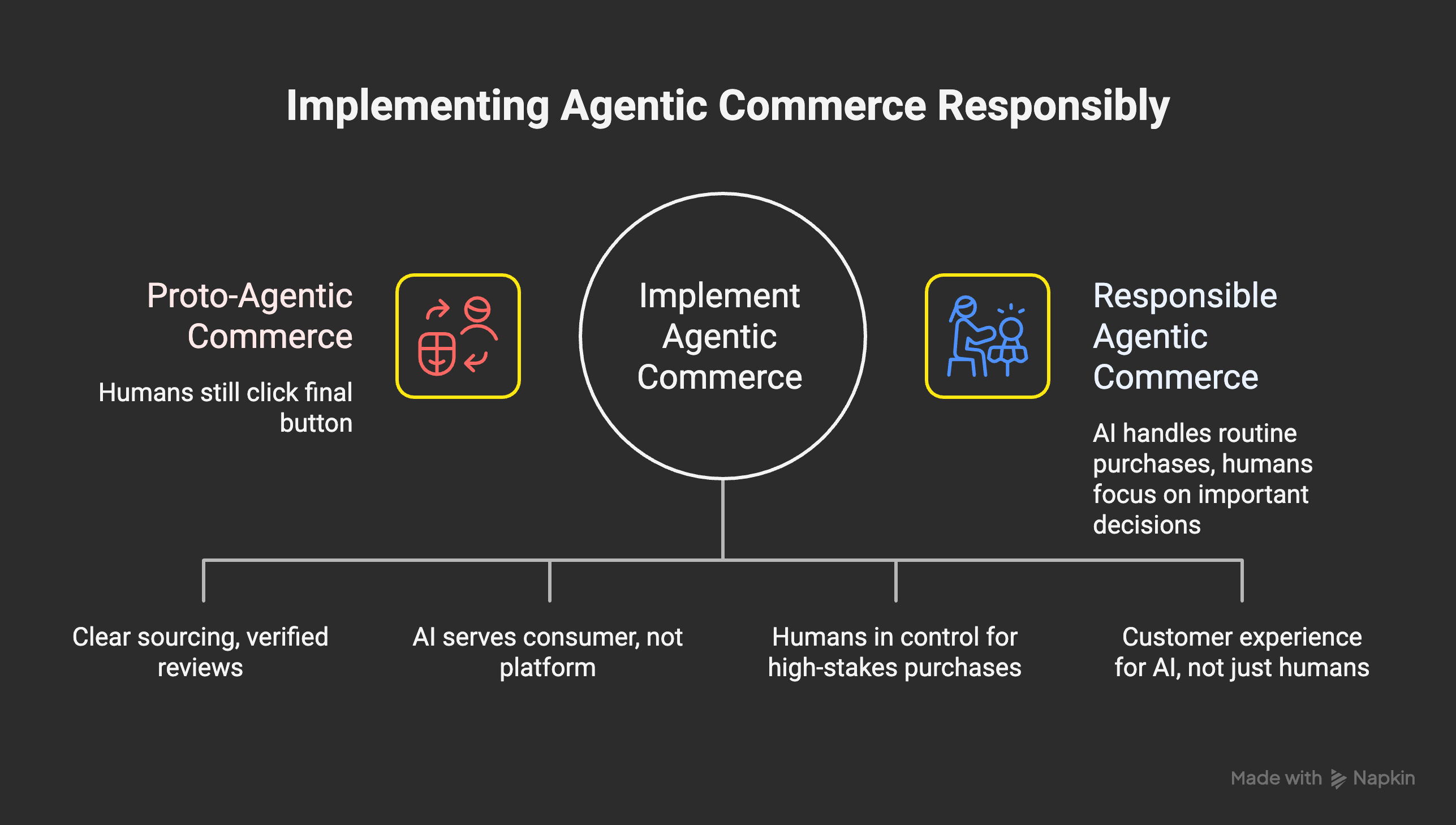
I keep thinking about my own shopping behavior. How much of it is actually me making decisions, and how much is already algorithmic? The Amazon recommendations. The personalized email offers. The retargeting ads that somehow know I looked at that specific thing once. We’ve been living in proto-agentic commerce for years. We just had to click the final button ourselves.
But Here’s Where It Gets Weird
Trust is... complicated.
Only 46% of shoppers fully trust AI recommendations today. And 89% still verify the information before buying. That’s a lot of double-checking for a technology that’s supposed to save time.
There’s this fascinating tension happening: 38% of consumers already use AI when shopping, and 80% expect to use it more. But 88% want clear sourcing. 87% want verified reviews. 75% want to understand how the AI actually generated its response.
We want the convenience, but we don’t quite trust it yet.
And honestly? Maybe that’s healthy. Because the risks are real.
The Dark Side of Delegation
Here’s what keeps me up at night about agentic commerce...
Autonomous agents aren’t just interfaces—they’re decision-makers. And decision-making at scale introduces what I can only call systemic risk. One faulty prompt, one edge case the AI didn’t handle well, and suddenly you’ve got cascading unintended consequences. Wrong flight booked. Inventory overordered. A purchase that happens without actual consent.
Nearly 80% of financial institution leaders surveyed by Accenture expect fraud to increase because of agentic commerce. That’s not FUD—that’s the people who run the payment systems telling us to be careful.
And there’s a subtler issue too. When AI agents start making purchasing decisions, whose interests are they actually serving? The consumer’s? The retailer’s? The platform’s? The answer is probably “all of them” which is also “none of them” depending on how you look at it.
If an AI can negotiate better prices, great. But what if certain retailers pay to be prioritized by certain agents? What if the “best deal” your AI finds is actually the best deal for someone else?
We’re about to find out.
Where Does Human Agency Go?
This is the existential question, right?
Pinterest’s VP of product marketing made a point that stuck with me: “Where agentic AI will still be underdeveloped through 2026 is in fully autonomous, end-to-end shopping across brands and channels, especially for high-stakes or complex purchases.”
Translation: for anything that matters—health, finances, identity—people still want to be in the loop.
But “wanting to be in the loop” and “actually staying in the loop” are different things. The whole point of these systems is convenience. And convenience is habit-forming. Once you delegate your grocery shopping to an AI and it works perfectly for six months... how much attention are you really paying?
I wrote about the AI tools sweet spot a while back—when to use AI and when to run away. Agentic commerce is testing those boundaries in real-time.
What This Means For Retail (And Everyone Else)
If you’re building anything in e-commerce, everything just changed.
The primary buyer isn’t always a human anymore. Amazon’s Rufus, Google’s Gemini, specialized autonomous shoppers in mobile operating systems—these are the new gatekeepers. Your customer experience team now has to optimize for AI agents, not just humans.
Product data becomes even more critical. Structured information. Machine-readable specifications. Verified reviews. The agents need to understand your products in a way that goes beyond what a nice photo and clever copy can convey.
And pricing? Dynamic pricing just got a whole new meaning when both sides of the transaction might be AI.
My Take
Look, I’m genuinely excited about agentic commerce. The amount of cognitive overhead we spend on routine purchasing decisions is absurd. If an AI can handle my household supplies, track prices, catch me better deals, and do it all while I focus on actual work? Sign me up.
But I’m also... cautious. Maybe that’s just my age showing. I remember when the internet was going to democratize everything and then... well, you know how that went.
The technology is ready. The infrastructure is ready. The question is whether we’re ready. Whether we can implement this in a way that actually serves consumers, not just the platforms and retailers who control the agents.
I think we’ll figure it out. We usually do. But the next few years are going to be wild.
And honestly? I’m here for it. Just... keeping one hand on the manual override button.
PS. How do you rate today’s email? Leave a comment or “❤️” if you liked the article - I always value your comments and insights, and it also gives me a better position in the Substack network.
I think you're asking valuable questions, but the one I keep finding myself asking is, whose agent? When we talk about agents and agentic commerce, "whose agent" will matter more and more. Is it a platform LLM's? Is it the retailer's? Is it the consumer's? Is it one that someone builds for consumers that they pay for, knowing they'd never get around to building one themselves? That plays into your trust question. With ChatGPT introducing ads, that trust question is going to get new scrutiny all over again. Can it truly ever be "the consumer's own agent" if it's built on a set of platform LLM tools that could still be influenced by retailers and brands who pay for that influence? All I know is we're all in for very interesting times ahead. Maybe too interesting!
While i was reading the "What's Your 2026 Agentic Commerce Strategy?" I saw your comment and like the perspective unique and taking this same level of understanding i drafted for Platform product perspective in my article. https://poojithamarreddy.substack.com/p/agentic-commerce-part-1-what-platform