


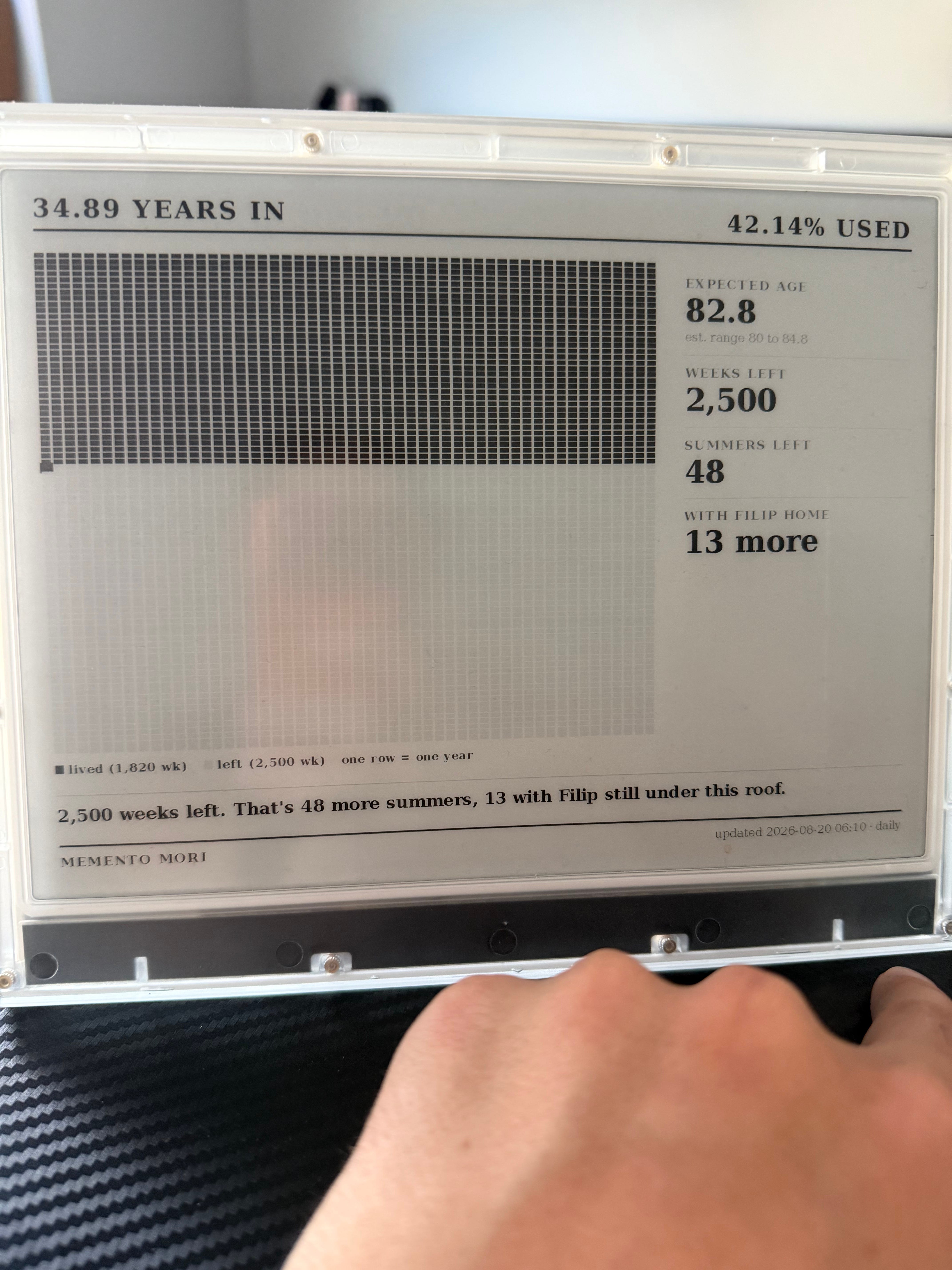
There is a small grey screen on my desk that says I have used 42.14% of my life.
I built that with my agent in an evening. My actual age, the average life expectancy in my country, a small bump for how medicine keeps improving, and out comes a number. Some of it is assumptions stacked on assumptions, I know. But it sits there, refreshing quietly, and I look at it every day.
I will get back to why I want that number on my desk. First I want to talk about the bigger thing this little device made me understand about hardware and AI, because this was never meant to be a review.
The device is called TRMNL, and for transparency: they sent me one for review, no money involved, and the other one is mine. But what I actually want to write about is the category, because I think something is changing.
Software always needed a surface
I have been building small apps for a long time. Way before AI coding, and much more since. It is always fun to make something of your own, but every app needs a surface to live on. That’s why I always leaned on the web: the web runs on nearly everything, from phones to tablets to fridges probably. And if the web is not enough, you can build for iPhone, Android, Mac, Windows, whatever.
With AI this whole thing became, I would not say easy, but definitely more approachable. If you have a good idea, you can at least get a proof of concept running, and a lot of people are discovering how good it feels to create something that is exactly theirs. Building is fun again, and the screens we already own are full of the things we build.
But for me there was always this other itch. Hardware.
The Flipper Zero itch
My first real taste of moldable hardware was the Flipper Zero. On paper a pentesting tool, in practice just a genuinely fun gadget with an open architecture that lets you make it do things nobody planned for. This was before I did much AI coding, and the feeling stayed with me: I want hardware I can mold into my own things, the same way I mold software.
Then I built my own AI agent, went deep into agentic AI, and pretty quickly a thought landed: everything my agent does lives on my computer screen. It made sense to extend it into something physical. Something that just sits in the room with me and does not need me to open anything.
That is how I ended up with an e-ink display on my desk. At first I was honestly skeptical whether a screen that refreshes every 15 minutes has a real use case for someone who scripts and experiments all day. Too long to read: yes, and it is fantastic.
What this thing is (the short version)
TRMNL is an e-ink display. No touch, no apps to poke at, a few buttons but manipulating things on it is beside the point. It shows you things. That is the whole job.
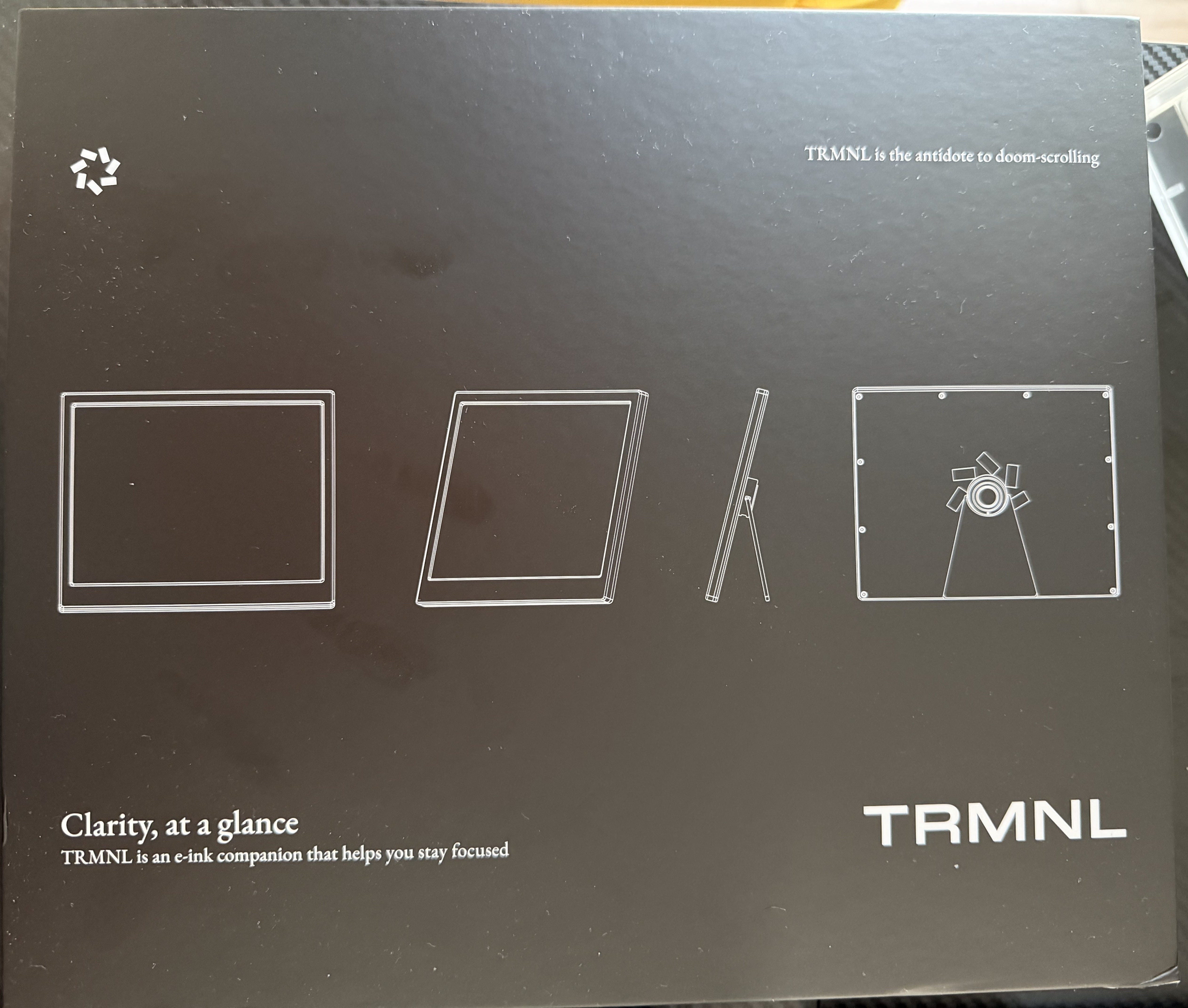
You do not need to be a dev to get value from it. There are over a thousand plugins on the platform now: calendars, task managers, weather, art, text, Hacker News, basically anything you would want at a glance, and the dashboard for setting it up is approachable for normal people. You pick what you want, it rotates through your screens, done.
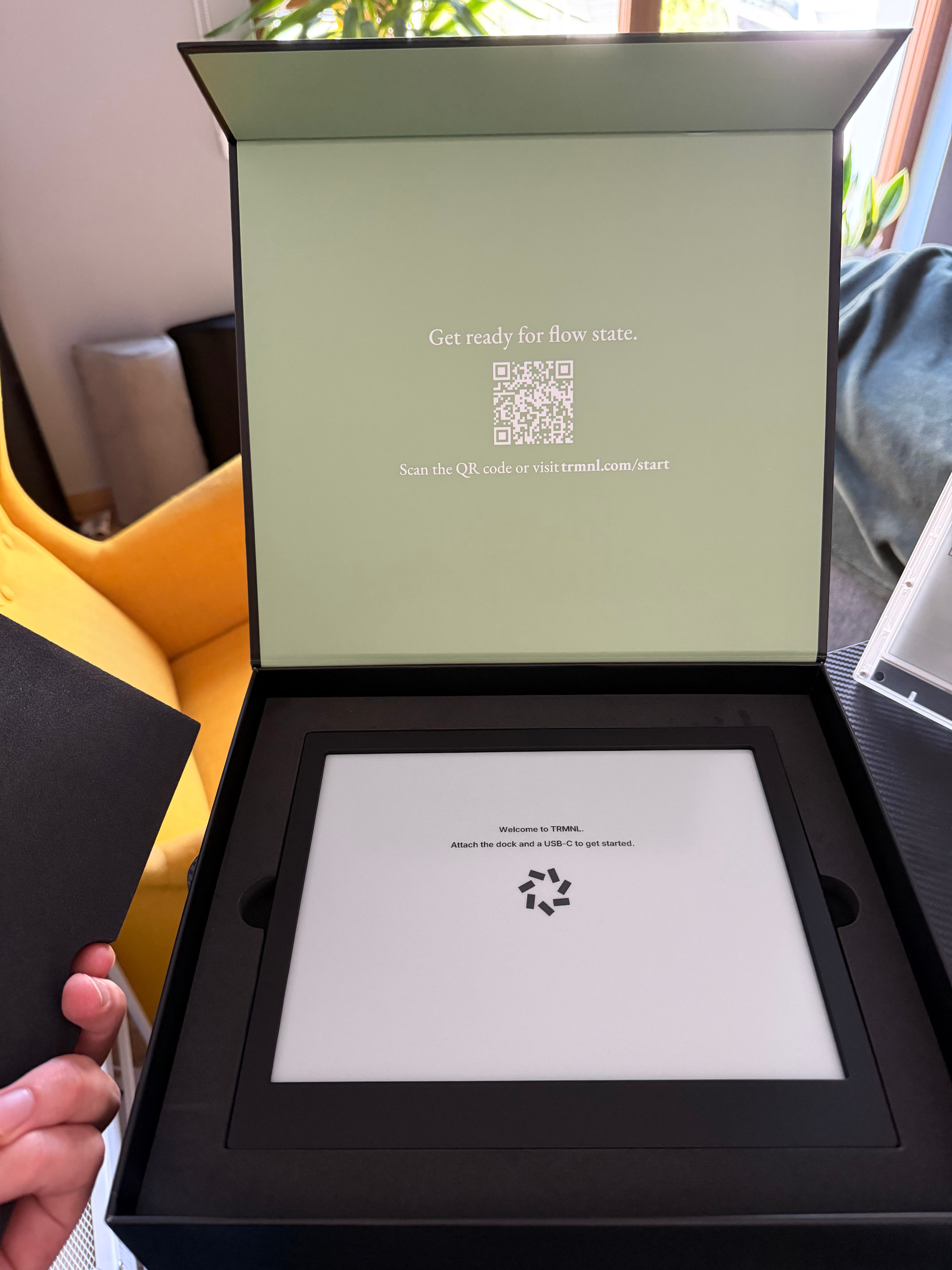
Depending on how often you make it refresh, the battery lasts up to three months on a charge. That number changes how you think about placement. This does not have to live on a desk near a cable. Hang it on a wall. Put it on the door so your family sees you are on a meeting. It becomes furniture with information in it.
That is the version for people who do not build. Now the fun part.
What happens when your agent owns the screen
The first thing I did was connect it to my agent and go for the low-hanging fruit: an at-a-glance dashboard. My calendar, my tasks, what is next in my lists, what my agent needs from me, decisions waiting for my call. Sounds like a standard dashboard, and honestly, you can get most of that from other apps.
Except there is a trick. The plugin is not fixed. My agent has access to it and decides what to show me and when. During work hours it leans toward work things. After hours it switches, or mixes both when something actually matters. It curates.
For how my brain works, this is the part that gets me. I have ADHD, and I have struggled forever with tools that were supposed to point me at the right thing at the right time. They were all deterministic: same widgets, same order, same noise, every day. This is the first setup I have used where the surface adapts to my day instead of me configuring it. The screen is dumb. The intelligence is behind it. That split turns out to be exactly right.
Then I started adding things nobody would ship as a product, because they only make sense for me.
The five-minute screen
When I am deep in work, small useful things for the body and mind just do not happen. So I made a plugin that shows me one thing I can do in five minutes. 30 jumping jacks. 10 slow breaths. It rotates through my whole day.
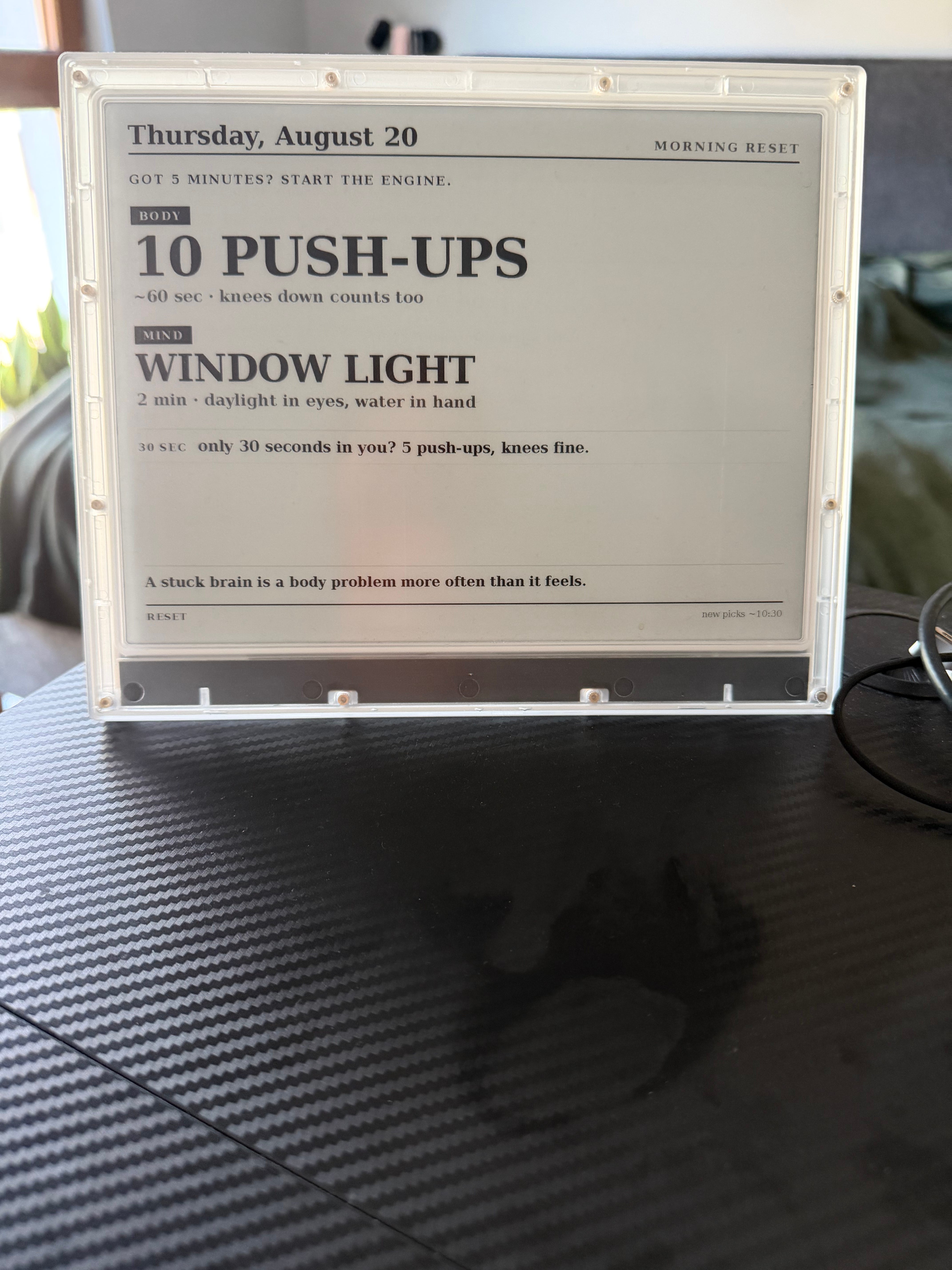
Like, instead of doomscrolling between meetings, I glance at the desk, see “10 slow breaths”, and sometimes I actually do them. Small things count, and a nudge that costs zero attention beats another app I have to remember to open.
The life counter
And then the 42.14%. A plugin that shows how much of my life is statistically behind me, with a visual of the weeks I have left. Sometimes it reframes: how many summers. How many years with my son while he still wants to hang out with me.
Not everyone will want this on their desk, I get that. But I have my own approach to death: it is a natural thing that is coming, and I would rather look at it than pretend otherwise. I wrote before about what Frieren taught me about time, and this counter is the same idea made physical. My time has an expiration date, so I should fill my days strategically. It does not mean every day must be the best day of my life. Some days are lazy, some are worse, that is fine. The counter is just a quiet nudge to do more anyway.
When I was building it, nothing like what I wanted existed. So I made my own, with my agent, and now it is exactly how I wanted it. That sentence is the entire point of this post.
The rest of the rotation
I also run a momentum dashboard for this blog: subscribers, weekly growth, paid subscribers, trends, when my last post went out. Plus two plugins straight from the catalog: days left in the year (they go fast), and Hacker News.
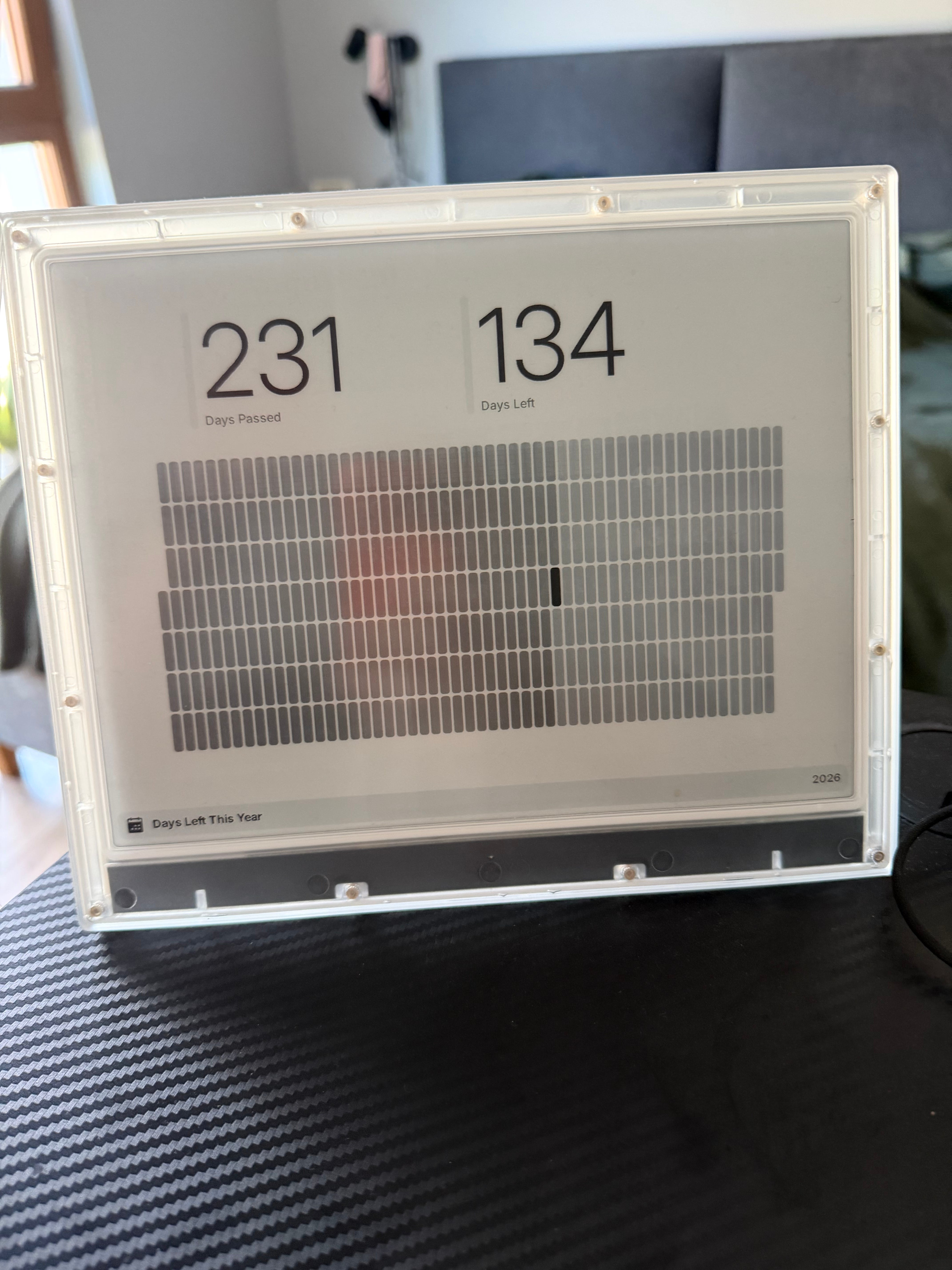
Funny effect of that last one: I visit the actual HN site way less now. The top stories pass by on my desk, and only when something catches my attention do I go read it.
The honest part
Things I would criticize, and I tried: color could add some depth to what it shows, but the company already sells a color version, and I actively prefer the black-and-white one. Grayscale is calm. I do not want another loud rectangle in my life. The 15-minute refresh felt limiting for about a day when I was building my first plugin (there is a paid tier with faster refresh), then I realized nothing I show needs to move faster than my day does.
I have two units, black and transparent, and the transparent one is genuinely cool: you see through to the batteries and circuit boards. It is heavier than you expect, mine has the extended battery, but this is a device you place once and forget, so the weight does not matter.
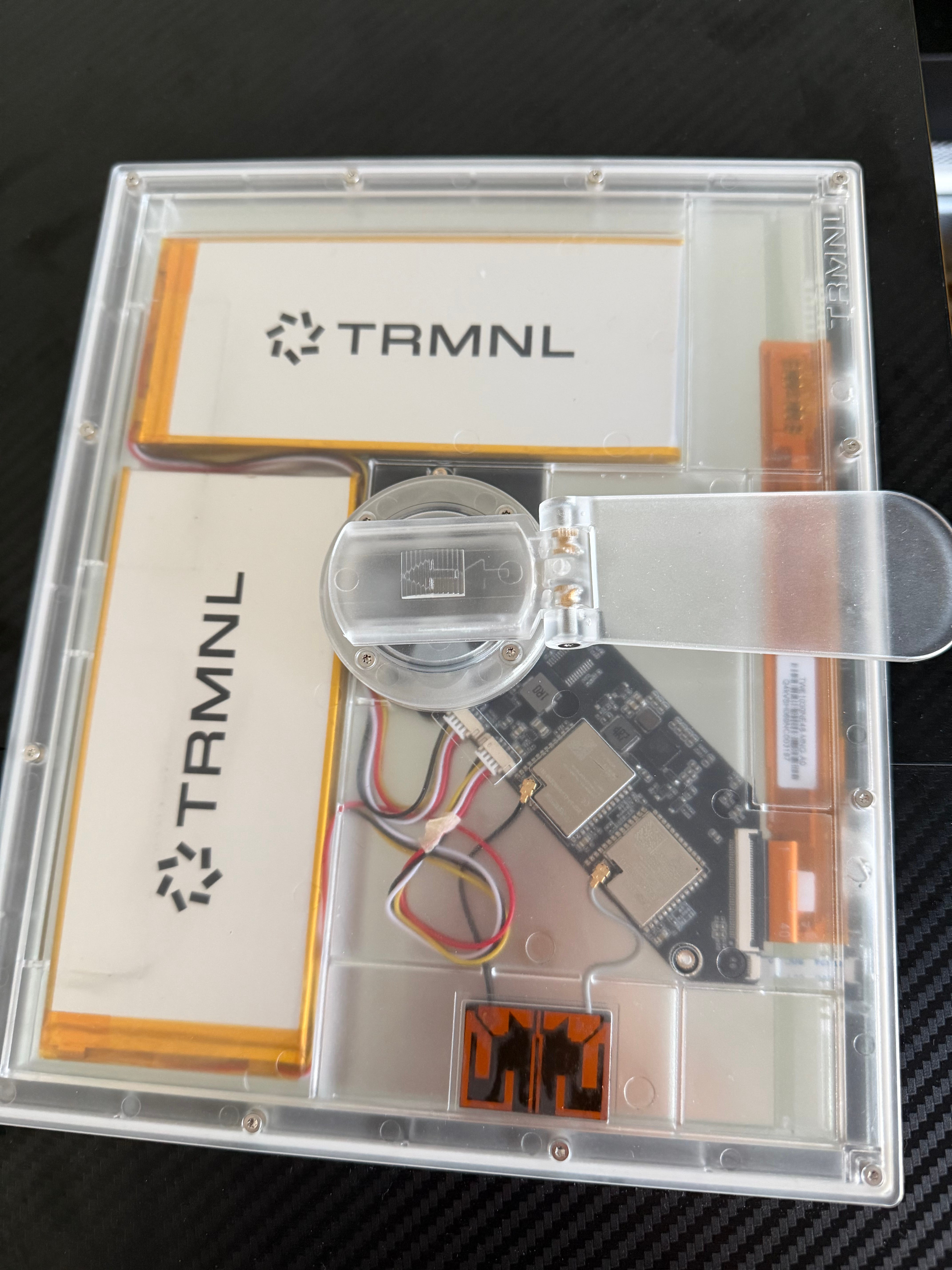
What actually won me over is how open the whole thing is. The firmware is open source. If you do not want to buy their hardware at all, they publish instructions to build your own device and use their software with it, people even run it on jailbroken Kindles. No catches I could find, and believe me, I looked. The way they build and sell this thing matches how I think hardware should be done.
They even give you an AI agent on the platform that helps you build custom plugins without writing code. I never used it, I have my own agent and my own ways, but it means the “build your own things” door is open for people who do not.
Hardware in the AI era
Here is the high-level thing I keep coming back to. For years, hardware for normal people meant fixed function. You bought a device that did the thing it did, and when you outgrew the thing, you bought another device. The interesting AI hardware stories of the last two years were mostly about cramming intelligence into the device itself, and I have tested some of those on my own body, with mixed feelings.
This is the opposite pattern, and I think it is the better one. The device stays simple, cheap, and calm. A $139 grey screen. All the intelligence lives in your agent, your scripts, your systems, and the hardware becomes a surface your software reaches into the physical world through. My agent works all day inside a computer. Now a piece of it sits on my desk, on paper-like ink, and taps me on the shoulder without ever asking me to unlock anything.
With AI, the distance between “I wish I had a screen that shows X” and having it is one evening. That changes what hardware even is. You stop asking “what does this device do” and start asking “what do I want it to do”, the exact question I keep telling you to ask about software. All you need is an idea of how it fits your workflows: personal, work, a mix. The flexibility is there, waiting.
Mine shows breathing exercises, my son’s remaining summers, and Hacker News. Yours would show something completely different. That is the point.
If you want more experiments like this, where I wire real hardware into my agent and tell you honestly what worked, subscribe. The next ones are already on my desk, literally.
This is awesome! I have a TRMNL but haven't hacked around with it much. How'd you convince them to send you one for review?
The Hacker News bit is the one I keep rereading. You visit the site less because the good stuff passes your desk anyway. That is a bigger claim than the hardware.
Every feed I use is built to make me browse. The moment something curates on my behalf, browsing turns into a choice instead of a habit. Same reason the deterministic dashboards failed you: same widgets, same order, every day, which lands pretty close to showing nothing.
The part I'd push on: your agent decides what to show and you can't see what it dropped. When mine started filtering my reading, the misses stayed invisible for weeks. I ended up wanting a "what you didn't see" screen more than the dashboard.
I run a version of this before I publish, checking which themes actually showed up across the people I follow. That is what snapfast.ai came out of.