


A few days ago I was scrolling X. No goal, just scrolling. A very popular account posted a list: 10 healthy habits, do these and you'll live longer. Something like that. You know the format.
I read them and they were compelling. My first thought was "okay, these are probably right."
But I'm a skeptic by nature. So I opened a thread with Wiz, my agent, and asked for the opposite of what these lists usually get. Deep due diligence. Go find evidence against every single one. If a habit survives someone actively trying to kill it, fine, it stays.
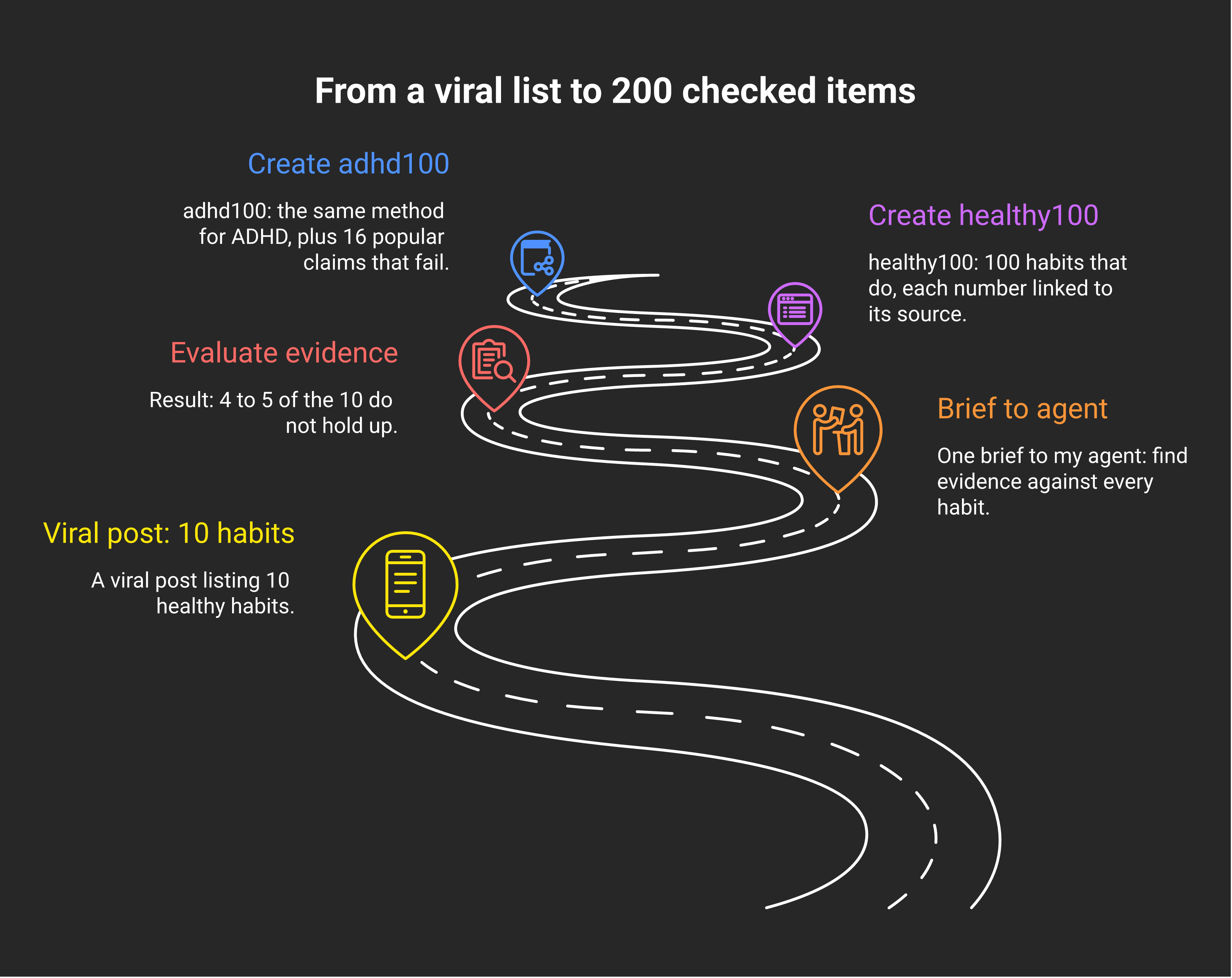
Out of ten, at least four didn't survive. Maybe five, depending on how strict you are with "partly true."
Forty to fifty percent. From a list that sounded completely reasonable to me five minutes earlier.
The easy post I didn't write
The obvious move was a debunk. Screenshot the list, go habit by habit, dunk on it. That kind of post travels well.
I thought about it for a while. Then something else bugged me more. If Wiz could find strong evidence behind some of those habits, the evidence exists. It sits on WHO pages, in CDC numbers, national guidelines, Cochrane reviews. It's boring to read and nobody posts it with a hook.
So I flipped the question. What does the current science actually support? And can I make that as easy to scroll as the viral list?
I picked a round number. 100.
healthy100
healthy100 is 100 things adults can do for their health. Each one has one number and the public sources behind it, linked, so you can open them yourself. You don't have to trust me. That's kind of the point.
The ranking is population impact: how much a thing changes death and disease, combined with how many people actually have the gap. Which makes number one very unsexy. Stop smoking, with support. "Quitting smoking can add up to 10 years to life expectancy," says the CDC. Number two is a weekly aerobic habit. Number three is checking your blood pressure, because about 600 million adults with high blood pressure (44%) don't know they have it.
Nothing in the top five would go viral on X. All five come with the numbers.
64 of the 100 items sit at evidence grade A (meta-analyses of randomised trials or major guideline consensus). Two are grade C, and the site says it plainly: worth knowing, not worth betting on.
Then there's "For me." Add your age, sex and country, plus whatever else you want to share (smoking, sleep, shift work), and the list re-sorts live. And there's "What can I do right now?": pick 1, 5, 15 or 30 minutes and you get real actions, highest impact first. An item with no honest one-minute version skips that tier instead of getting a fake one. It's the cheerleader version of a health list, with a cheerleader that doesn't lie to you.
There are no logins, accounts, cookies, analytics or backend. Your answers never leave your browser. I thought about adding any of that for about three seconds. It's just not necessary, and a site that asks how much you drink has no business storing the answer.
It's live in seven languages: English, Polish, German, Ukrainian, Czech, Dutch and Spanish.
Then the harder one: ADHD
healthy100 is general. You can tailor it, fine. But I kept coming back to one question: what about my condition?
I have ADHD. I wrote about it in April. And if you think general health advice online is noisy, try ADHD. Supplements, diets, apps, "5 signs you have ADHD" videos, "you'll grow out of it," "it's just sugar." Some of it helps. A lot of it doesn't. From the inside it's really hard to tell which is which.
One number from the research made me laugh, a bit bitterly. In a 2022 study of 100 popular ADHD TikTok videos, clinicians classified 52% as misleading. More than half. Same feeling as my ten habits.
Right when I was finishing healthy100, a Polish newspaper wrote about scientists who went through more than 4,600 publications on ADHD to see what works. That's the BMJ umbrella review by Gosling, Cortese and colleagues from late 2025: 221 re-estimated meta-analyses, 31 interventions. Its conclusion is uncomfortable. A few things have solid short-term evidence (mostly medication, plus CBT for adults). Many popular things have weak evidence. And for the long term, no intervention has high-certainty evidence at all.
So adhd100 had to work differently.
100 honest things, when there aren't 100 proven ones
I hit the problem immediately. There aren't 100 ADHD-specific interventions with good evidence. There just aren't. I could pad the list and pretend, like every ADHD content farm does.
Instead, every item on adhd100 shows how sure the science is, and whether the evidence was measured in people with ADHD or borrowed from the general population. 68 of the 100 are ADHD-specific. 32 are general health things that matter extra for us (sleep, movement, that kind of stuff), labelled as such.
The certainty split is honest to the point of being a bit ugly. Only 8 items reach moderate or high certainty. 82 have no formal certainty rating at all, and the site separates those into guideline-backed and simply not graded, so a clinical guideline doesn't look like ignorance.
The top of the list isn't exciting either. Talk to a clinician about methylphenidate (for your child, or for yourself). Get an assessment. Plan medication changes with your doctor. The site never pushes medication and never argues against it. It shows the evidence, and you and your clinician decide.
Then there's the page I like most: Doesn't hold up. 16 popular claims the evidence doesn't back. A few of them:
Sugar causes ADHD. A meta-analysis of 23 blinded sugar challenge studies in children found no clear effect on behaviour or cognition.
Omega-3 treats ADHD. A 2023 Cochrane review of 37 trials found no difference from placebo in parent-rated symptoms, and rated that high certainty.
You'll grow out of it. In the MTA follow-up of 558 kids with ADHD, only 9.1% showed sustained remission by young adulthood.
Caffeine works as treatment. Seven small trials, 104 children, no clear difference from placebo overall.
A TikTok symptom list can tell you that you have ADHD. See the 52% above.
Each myth links to the items that do have evidence, so "no" never ends in a dead end.
The form is different too. An ADHD site designed like a normal health site is exactly the thing I bounce off. So adhd100 puts one decision on the first screen, a one-minute line you can scan on every item, the list in blocks of ten, and a progress meter. For how my brain works at least, that's the difference between reading ten items and reading a hundred.
Who built it
Opus 5.5 built most of both sites. Anthropic released it on 22 September and pitched it as Fable-level performance at a much lower price. For building, verifying and translating, I'd agree. It carried almost everything.
Almost. Design went to Fable, and a Fable pass reviewed the UI and UX on real data before I saw a link. Opus is great, but for frontend design Fable is still better in many small ways, the kind you feel before you can name them.
Research went to GPT-6 Astra (the model that got me back to Codex), and every slice was fact-checked by a different model than the one that researched it. Nobody grades their own homework. I've leaned into that since I ran five different agents against five clones.
A lunch break for a crisis line
One moment from the build stays with me more than any ranking.
During healthy100's translation QA, a checker model flagged the Dutch suicide prevention line, 113. Its chat supposedly closed for lunch, 12:00 to 12:30. The orchestrator opened the official 113 page, which says the chat is open day and night, and rejected the flag.
If that "fix" had gone through, a site built to help people would tell someone in crisis that help is on a lunch break. The checker was confident and wrong. Same lesson as 16 models and a dead king, one layer up.
No doctor reviewed either site, and both About pages say so. What they have is a chain of checks where every link is allowed to be wrong, and the next one has to go read the source. I don't know how many people will use them. Fine by me, I build my own things anyway.
If you like watching a skeptic and his agent check things before believing them, subscribe. The failures stay in.
I tried to read adhd100 site and, sorry, but it feels really bloated with seeimngly low-signal information: info labels, buttons, suggestions, everything is streaming on you distracting from key things. Interface is overloaded with controls and semantic areas. Also, the more I read, the more I feel it was written by an AI, which undermines the whole thing and creates more uncertainty than before my attempt to read it all.
--
But I've found something really curious: mindfullness practices were highlighted there as something with no certain outcome or guarantees, yet with seemingly large impact. Personally, I think I have adhd-like mindset and recently I started to study my self with that respect. My guess is that introspection is outside of scientific method by its nature, but that doesn't mean humanity does it for thousands of years for nothing :)
I want to propose a reflective approach to this phenomenon of ADHD-like behavior, which is close to mindfullness practice as I see it.
--
For example, before I was going to read your article on ADHD (ironically) I was going to check my e-mail to find something particular in it. Then, your article caught my attention. I *felt* that interesting and gave into it. After several minutes I noticed: "What the hell am I doing? It's half past 3 P. M., and I wasn't planning all that." That brought me back "on time" and I remembered what I wanted to do.
Now, similar impulses do arise pretty often in my life, but they are noticeable and traceable as such, most of the time there is some logic to it. But sometimes it looks like total identification with an impulse, "all in" for the joy of that thought stream. Funny enough, one of my friends decided to not struggle with finding a way to use that feature of his mind and accepted that identity quite literally, saying "dophamine's my second name", that tells something raising certainty in my self-observations.
So it is observable and only if I don't emotionally invest in those observations, do not want to do them - I can go really rampant and have tons fun doing nothing in particular. Which is less and less available the more you become adult.
But also I can tell:
- I don't behave this way everyday. Sometimes I enjoy quite not-so-motivated being, which shows there is a variety of states I can be in.
- Caffeine boosts this behavior by increasing my excitability. And I do like that, which I found truly crucial.
- Goal-oriented behavior is known to me, but there often were quite perceptible obstacles to it. First of all, it was always hard to find a direction into which I will believe firmly and to which I will commit. So it was always easier to walk a path than to climb a mountain, and that tells something about my worldview and values, which, I don't doubt, have formed over time. It is not like I was always struggling to pursuit goals, they just seemed meaningless or loosing their actuality very quickly. That is something one can call short-term benefit orientation, and that may be true, **but it is naturally easier to see what's in front of you than to foresee how tides will change and to stick to ever-ephemeral goal created by your mind**, withstanding all the unexpectancies. Commitment has its toll. But it turned out, the other side of the coin was that I always loved improvization without even noticing that, and at some point in life I even practiced that art for a while. Curious, don't you think?
That being said, I still do believe that in my case it has more to do with value system and mindfullness rather than with purely biological causes, like a way to know my inclinations, why do I give into them and taking responsibility for each choice. And I think, since ADHD is really flooding the Web nowadays, this wasn't as common some tens and hundreds of years ago. Everyone seems to have ADHD now, lol. Actually, discipline wasn't ever easily achievable quality of personality, it was always considered gold.
--
To sum up: I gathered a lot of self-observations throughout my life to be skeptic on medical treatment of this behavior. It has a lot to do with orientation on feelings, they way I identify myself with something (especially my own thoughts and the process of thinking), if I am aware of how my attention spreads and where, with my values and what I consider valueable to pursue. To some degree it even seems rather frightening to think that some magic pill will make me better. Maybe it will make me so different I won't feel me myself again. By the way, that experience I had without any pills, just studying math so hard that all thoughts collapsed and my attention span felt so rigid and stable that I felt like I don't have thoughts familiar to me, like it was "unlike me to see the world this way". So I gently brought it back by doing nothing and giving into "unconstrained thinking", after some month or two it came back.
P. S.: I gladly spent some time to write this stuff, although that also was an impulsive act. I do this all life, but somehow it is just a part of me, it comes with a price though, but has its benefits.